
Why an Industrial ID Badge Needs to Withstand Real Work
An industrial ID badge needs to do more than look clear when it is first issued. It must keep identification readable and credentials usable through the conditions of a working facility. Dust, moisture, abrasion, chemicals, temperature changes, and repeated movement all influence how well the card, holder, and attachment perform together.
Build an industrial ID badge system around the job
Start with the worker’s actual tasks. Someone who frequently presents a credential to a reader has different attachment needs from someone whose badge stays clipped to a work vest. A maintenance role may involve different cleaners, movements, and protective equipment than a warehouse reception role. Choose the whole system around these differences rather than buying every worker the same setup.
Evaluate the card, protective layer, holder, reel, and attachment as one system. Readability, reliable credential use, and compatibility with required protective equipment all matter.
Choose Card Materials and Protection for the Worksite
Compare PVC, composite PVC/polyester, and polycarbonate cards using the conditions they will actually encounter. Material names are a starting point, not a complete durability specification. Ask suppliers about the finished card’s thickness, bending performance, temperature range, and suitability for your printing and credential requirements.
- PVC: Review the proposed card’s performance against routine handling, site temperatures, and cleaning exposure.
- Composite PVC/polyester: Compare its documented bending and temperature performance with the PVC option being considered.
- Polycarbonate: Check the finished card’s specifications and compatibility with the intended printing, protection, and credential setup.
Then assess the overlay or laminate against the facility’s cleaners, oils, moisture, and abrasion. Ask which substances and conditions were tested rather than accepting a broad claim such as “industrial strength.” A protective layer should preserve the printed information, but it also needs to work with the selected card and holder.
Request samples and test the complete arrangement under representative site conditions. Inspect the card surface, edges, print, and protective layer afterward, and confirm that the credential still works with the intended reader. Include the holder and attachment in this assessment.
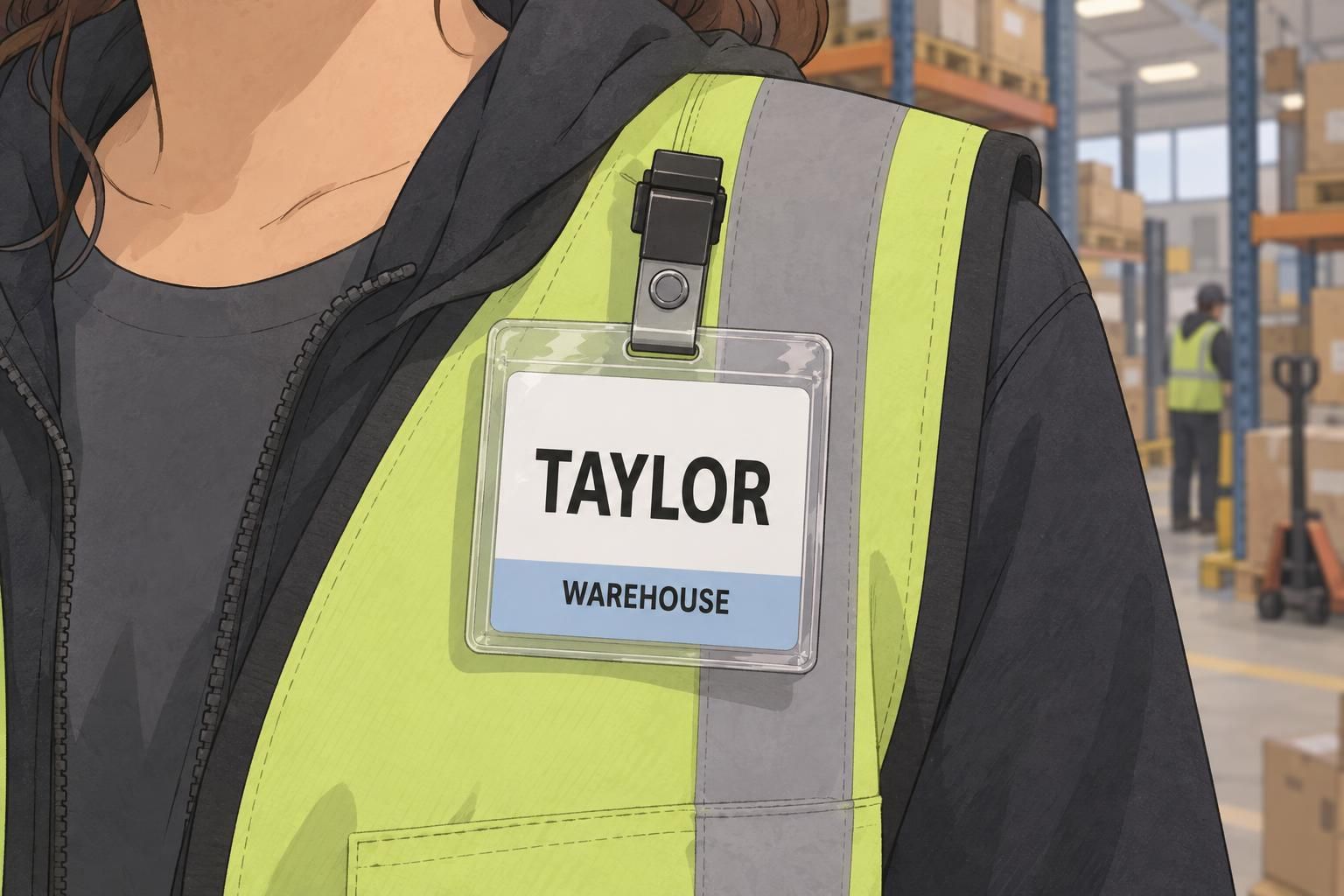
Keep Names and Warehouse Identification Easy to Read
Good warehouse identification should be understandable at a glance. Use a clear photo, large name text, strong contrast, and a simple role or access-zone label. Give the most important information enough space instead of crowding the card with details that people cannot easily read during normal work.
Color coding can help distinguish employees, contractors, and visitors, but it should not carry the entire message. Pair each color with readable text or another clear label. For example, a visitor badge can use both a distinct background color and the word “VISITOR,” making its purpose clear without requiring someone to remember a color chart.
Review the layout inside the actual holder and in the intended wearing position. A clear design becomes less useful if the holder obscures a label, the card turns inward, or protective clothing covers the name. Check visibility with the equipment workers normally wear.
Select a Durable Badge Holder and Reliable Reel
A durable badge holder should retain the card securely and protect it from the wear found on the job. Check the fit with the exact card thickness and protective layers you plan to use. The card should remain secure during normal movement, while its identifying information stays visible through the holder.
- Retention: Check whether the card stays seated when the worker bends, reaches, and walks.
- Protection: Inspect how the holder shields the card’s surface and edges from expected wear.
- Attachment fit: Confirm that the holder connects securely to the selected clip, reel, or lanyard.
- Visibility: Check whether the badge remains outward-facing and readable in its working position.
- Reel performance: Test extension and return with the complete card-and-holder combination.
Match reel strength to the actual load and frequency of use. A reel that handles a bare card may perform differently with a heavier holder. During testing, check that workers can reach the reader without awkward movement and that the badge returns to its intended position. Keep placement compatible with PPE and away from moving equipment.

Make Attachment Choices Compatible With PPE
Choose breakaway lanyards, secure clips, or retractable reels according to the task and required personal protective equipment, or PPE. No single attachment is the best choice for every role. Consider both how the badge is displayed and how it moves when the worker performs routine tasks.
A breakaway lanyard should not be treated as permission to let a badge hang near machinery. Where snagging or entanglement is a concern, assess whether a secure clip or another placement is more suitable under the facility’s procedures. The goal is visible identification without interfering with protective equipment or introducing avoidable attachment concerns.
- Check the badge position while the worker wears the full PPE required for the task.
- Confirm that the card, holder, and attachment do not obstruct protective equipment.
- Observe routine reaching, bending, and reader use in an appropriate testing area.
- Set role-specific placement guidance rather than assuming one position works everywhere.

Coordinate Visible Identification With Access Control
Use the visible industrial ID badge to communicate identity and broad authorization categories, such as employee, contractor, or visitor. Manage detailed permissions through the facility’s access-control system. A printed role or color label should not be treated as a substitute for the permissions assigned to the credential.
Before selecting cards, confirm compatibility with existing readers and credential procedures. Test the proposed credential in its intended holder and carrying arrangement, including the normal reader locations. NIST’s guidance on PIV credentials and physical access control provides relevant context for credential and system compatibility; organizations should follow the requirements of their own systems and procedures (source).
Establish clear processes for issuing credentials, reviewing access, and promptly deactivating lost or no-longer-needed badges. Workers should know where to report a missing credential. Replacing the physical badge and addressing its access permissions are related tasks, but both need attention.
Pilot, Inspect, and Replace Badges as Needed
Run an on-site pilot before adopting a badge arrangement broadly. Include representative workers, tasks, protective equipment, and environmental conditions. A setup that performs well at a desk may need adjustment when used repeatedly at warehouse readers or during manufacturing work.
- Check whether names, photos, and role labels remain readable.
- Inspect card condition and holder retention after representative use.
- Observe reel extension, return, and attachment security.
- Confirm visibility and PPE compatibility during routine movement.
- Verify reader performance and the process for reporting lost credentials.
Use the pilot results to set a practical inspection and replacement process. Replace damaged, hard-to-read, or outdated badges, and address holders or reels that no longer perform reliably. Make reporting straightforward so workers can flag a cracked holder, unreadable card, or missing credential without uncertainty about the next step.

Questions to Ask Before Choosing Badge Supplies
Ask questions about the complete badge system, not just the card. Supplier specifications help narrow the choices, while samples let you assess how the components work together in the intended environment.
- What card thicknesses and materials are available, and which fit the proposed holder?
- Which protective layers are offered, and which chemicals or cleaners have been tested?
- What temperature, bending, and abrasion performance is documented?
- Does the holder retain the finished card securely during representative movement?
- Can the reel reliably extend and retract with the selected card and holder?
- How will the attachment fit with each role’s required PPE?
- Is the credential compatible with existing readers and access-control procedures?
- What replacement options and credential-deactivation processes will be used?
The right industrial ID badge combines readable identification, suitable protection, reliable attachments, and manageable credential procedures. Choose a durable badge holder and reel based on real work, verify PPE compatibility, and keep inspection simple. That approach supports clear warehouse identification throughout everyday use.