
Customer trust name tag visibility: Why it matters in service roles
Why a customer trust name tag changes the service experience
A customer trust name tag does something deceptively simple: it removes the awkward first step of figuring out who to talk to. In a service interaction, customers are often trying to solve a problem quickly—returning an item, checking in, finding a product, asking about a policy. When a name is clearly visible, the conversation starts with clarity instead of uncertainty.
That clarity supports comfort. People tend to relax when they can address someone directly (“Hi, Sam—can you help me with this?”) rather than speaking into the air or guessing at someone’s role. It also supports everyday accountability in a healthy way: when identification is easy to see and consistent across a team, customers know they’re speaking to a real, responsible representative of the business.
The goal isn’t to share more personal information—it’s to make service feel straightforward: easy to see, easy to read, and consistent across the team.
In public-facing roles, that balance matters. A visible, readable badge can help customers feel oriented and supported without requiring employees to reveal unnecessary details. Done well, name visibility makes the experience smoother for both sides: customers know who they’re speaking with, and employees spend less time proving they’re the right person to help.

Visibility, transparency, and trust: what customers infer from clear identification
In service settings, customers make quick judgments based on small cues: uniforms, tone of voice, posture—and whether identification is visible. Clear identification can read as “this person is authorized to help me,” which lowers the mental load customers feel when they’re already stressed, in a hurry, or navigating a new environment.
That’s where transparency comes in. When a workplace makes roles and names easy to see, customers often experience the environment as more organized and safer. This doesn’t require heavy-handed messaging; it’s the quiet confidence of a consistent system. Research on credential signals and perception supports the neutral idea that visible badges can shape impressions of competence and trust—especially when the identifier’s meaning is clear to the user (source).
- Faster routing: customers can quickly find someone who appears on duty and ready to assist.
- Lower friction: fewer interruptions like “Do you work here?” or “Are you the manager?”
- More comfortable communication: customers can address employees naturally by name or role.
- Clearer boundaries: visible identifiers help distinguish staff from other customers in busy spaces.
For teams, visibility also reduces internal confusion. During peak hours, a consistent approach makes it obvious who is working, who is covering a specific area, and who can approve exceptions. The result is smoother coordination without requiring customers to repeat their question to multiple people.
Choosing the right retail name badge for fast, friendly recognition
A retail name badge works best when it’s designed for real-life conditions: movement, varying lighting, quick conversations, and customers standing a few feet away. Legibility at normal conversation distance should be the non-negotiable starting point.
Prioritize a large first name with high contrast (dark text on a light background, or light text on a dark background) and keep extra elements to a minimum. Logos, patterns, or decorative backgrounds can be fine—until they compete with readability. When the name is the primary purpose, it should visually dominate.
- Use a large first name as the focal point.
- Choose high-contrast colors that stay readable under store lighting.
- Limit clutter (too many icons, taglines, or extra lines).
- Standardize placement (upper chest) so customers know where to look.
- Add role identifiers only when they improve routing (e.g., “Manager,” “Guest Services”)—and keep them smaller than the name.
Placement and consistency matter as much as design. If one person wears a badge on a lanyard, another on a pocket, and another on a sleeve, customers have to hunt for the name—defeating the purpose. When everyone wears it in the same spot (typically upper chest), recognition becomes automatic.

Privacy-safe name display tips for public-facing teams
Customer-friendly identification doesn’t require employees to reveal more than they’re comfortable with. Privacy-safe naming is common in public-facing work, and it can still support recognition and accountability when the policy is consistent and easy for customers to understand.
Many organizations choose first name only, a preferred name, or first name plus last initial depending on the environment, risk profile, and local policy. What matters most is that the approach is standardized across the team and reinforced during onboarding, so employees aren’t improvising.
- Use first name only when full names aren’t necessary for service quality.
- Consider preferred names to support comfort and smoother customer interactions.
- Use first name + last initial if your environment benefits from extra differentiation.
- For higher-risk environments, pair a first name with a role label (e.g., “Team Lead”) rather than adding more personal data.
- Align the naming standard with HR/security expectations and any local regulations that apply.
Avoid printing personal data—like full last names, employee IDs, phone numbers, or schedules—on outward-facing badges. Keep the outward-facing side focused on what customers need to interact respectfully and efficiently.
If your workplace requires additional information for internal processes (timekeeping, access control, or back-of-house verification), that information can often be handled through separate systems or formats rather than being displayed prominently to the public. The most effective service identification choices support customers while protecting staff.
Design essentials: readable names, clear roles, and durable wear
Design details can make or break usability. A name tag that looks good in a mockup but reflects glare under overhead lighting or becomes unreadable after regular cleaning doesn’t support customer comfort. Trust-building identification needs to hold up in the conditions it will actually face.
Start with readability: strong contrast, a clean typeface, and a type size that remains readable even when an employee is moving. Choose finishes that reduce glare when possible, and consider durability so edges don’t peel and text doesn’t fade.
- Glare-resistant finishes help names stay readable under bright store or lobby lighting.
- Strong color contrast improves quick recognition at conversation distance.
- Keep the name line dominant; place role or department as secondary.
- Use materials and printing that can withstand regular wear and cleaning.
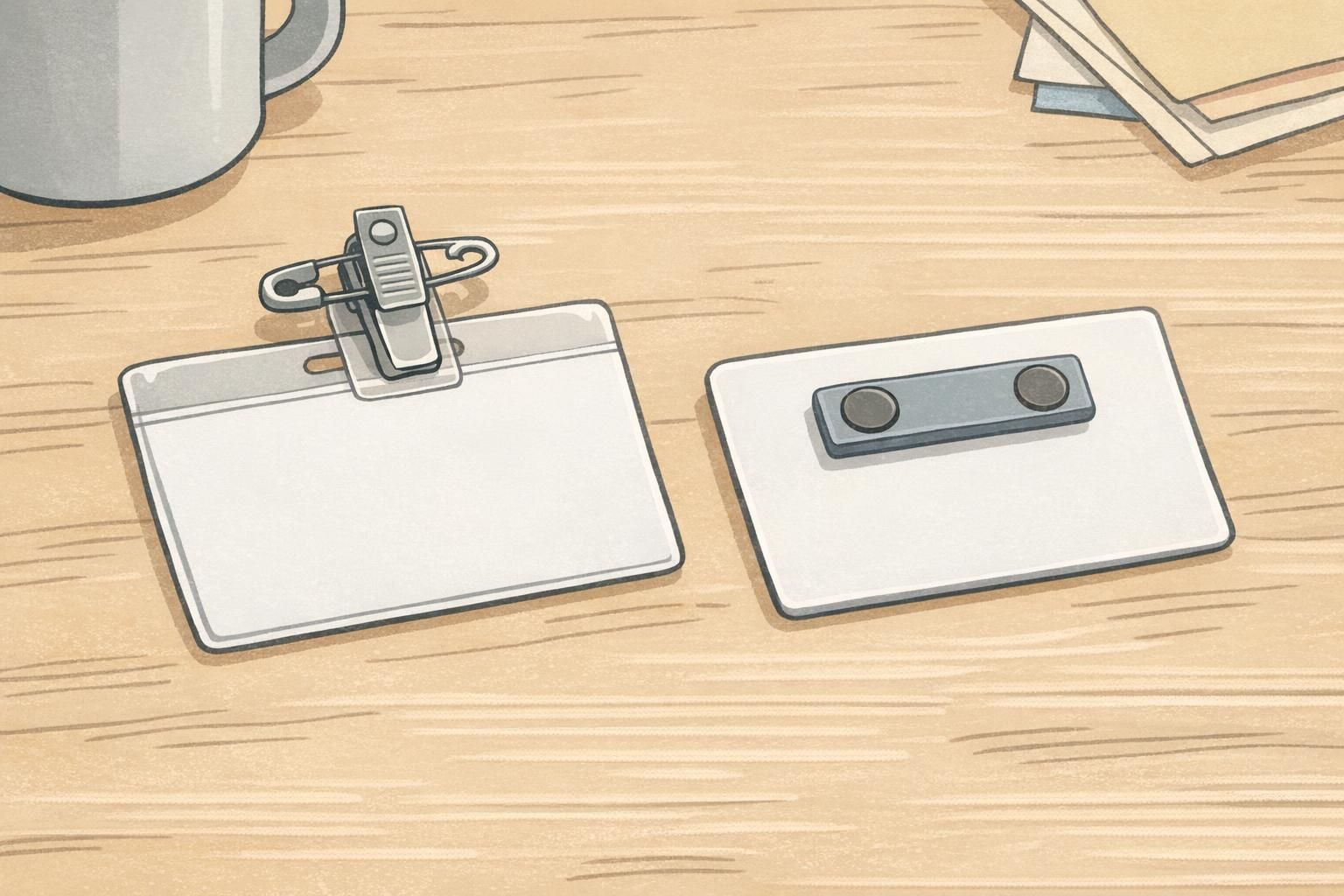
Attachment style is another practical decision. Magnet fasteners can be a good fit for dresswear where pinholes are a concern, while clips may suit uniforms and active roles. Lanyards can work well when frequent ID checks are required, but they can also swing and flip—so ensure the name side stays forward if the name needs to be visible.
Operational best practices: consistency, replacements, and badge policies
Even a great badge design can fail without clear day-to-day practices. Consistency is what turns identification into a dependable system rather than a personal preference. The more public-facing the role, the more important it is that customers can instantly recognize who is on duty and who can help.
A simple policy can cover the basics: where badges are worn, when they’re required, and how to handle visitors, temporary workers, and contractors. It also clarifies what to do when a badge is forgotten, lost, or damaged—because missing identification quickly becomes the norm if replacements are slow or complicated.
- Define standard placement (e.g., upper chest) and keep it consistent across roles.
- Specify when badges are required (front-of-house, customer-facing areas, events).
- Establish a visitor/contractor identification method so customers can distinguish staff.
- Maintain spares or a quick reprint process so lost or damaged badges don’t linger.
- Update badges when roles change to prevent misrouting and confusion.
“When everyone wears identification the same way, customers stop searching and start asking. That small change cuts down on escalations and keeps interactions calmer.” – Service Operations Lead
Training helps reinforce the benefit. Encourage staff to introduce themselves using the name on the badge—especially in longer interactions—so customers connect the visible identifier with a real person. This can improve comfort while also making handoffs smoother (“Jordan will take it from here”).

Product fit: name tags and ID solutions that support service identification
Different environments call for different service identification choices. Some teams only need a clear name for friendly recognition. Others need role labels for routing (like “Manager” or “Pharmacy”), or ID badges in holders for frequent checks. The best fit is the one that keeps identification readable and consistent while matching your privacy approach.
For service teams that want reliable, consistent identification, BadgeZoo’s customizable name tags and ID badge options make it easier to standardize designs while keeping names readable and professional. You can explore options like finishes (including matte/silk when glare reduction matters) and choose attachment styles that suit uniforms or dresswear. If you’re comparing approaches, start with visibility requirements and privacy boundaries, then match the badge format to your day-to-day workflow.
If you’re evaluating badge layouts for customer-facing roles, custom name tags for service teams can help you standardize name prominence and role labels without adding unnecessary complexity.
Quick checklist: improving customer comfort without oversharing
A few small checks can dramatically improve how customers experience your service team. The goal is simple: make identification readable and consistent, while keeping personal details appropriately limited.
- Readability: Can the name be read at a normal conversation distance?
- Placement: Is the badge worn in the same location (ideally upper chest) across the team?
- Role clarity: Where helpful, is the role shown in a secondary position without overpowering the name?
- Privacy: Are you using first name, preferred name, or last initial in line with your policy and risk level?
- No oversharing: Have you removed unnecessary personal data (full last names, IDs, phone numbers, schedules)?
- Accuracy: Are badges updated promptly when roles or departments change?
- Continuity: Is there a replacement process so lost/damaged badges don’t become “normal”?
- Onboarding: Do new hires, seasonal staff, and contractors receive the same identification standard from day one?
Not necessarily. Many teams use first name only or first name plus last initial. The best choice depends on your environment, role risk, and internal policy—while still keeping the name readable and consistent for customers.
Typically the upper chest, where customers naturally look during conversation. Consistent placement across employees reduces awkward scanning and speeds up interactions.
A name tag is usually optimized for customer recognition (big, readable name). An ID badge may include additional elements used for access, verification, or internal processes and is often used with holders or lanyards.