
Why a Transportation ID Badge Must Be Quick to Verify
A transportation ID badge has to work in two ways: people need to recognize it quickly, and authorized readers need to process it reliably. At an airport staff entrance, transit maintenance area, or transport depot, those needs meet in an everyday interaction. A worker presents a credential, someone checks it, and the worker continues according to the facility’s procedures.
Clear photos, readable details, and predictable badge placement make that interaction easier. When a badge faces outward in a consistent location, staff spend less time asking the wearer to turn it around or uncover the photo. A suitable holder also helps keep the card visible without making it awkward to present to a reader.
Quick checks start with a transportation ID badge
Quick verification is not the same as skipping verification. The aim is to remove avoidable delays while preserving the checks required for that role and location. Visual recognition supports the process, but appearance alone does not establish that a credential is current or that its holder has permission to enter.
A facility-issued employee badge identifies a worker within a workplace system. It should not be confused with an official traveler identification document or treated as a substitute for one.
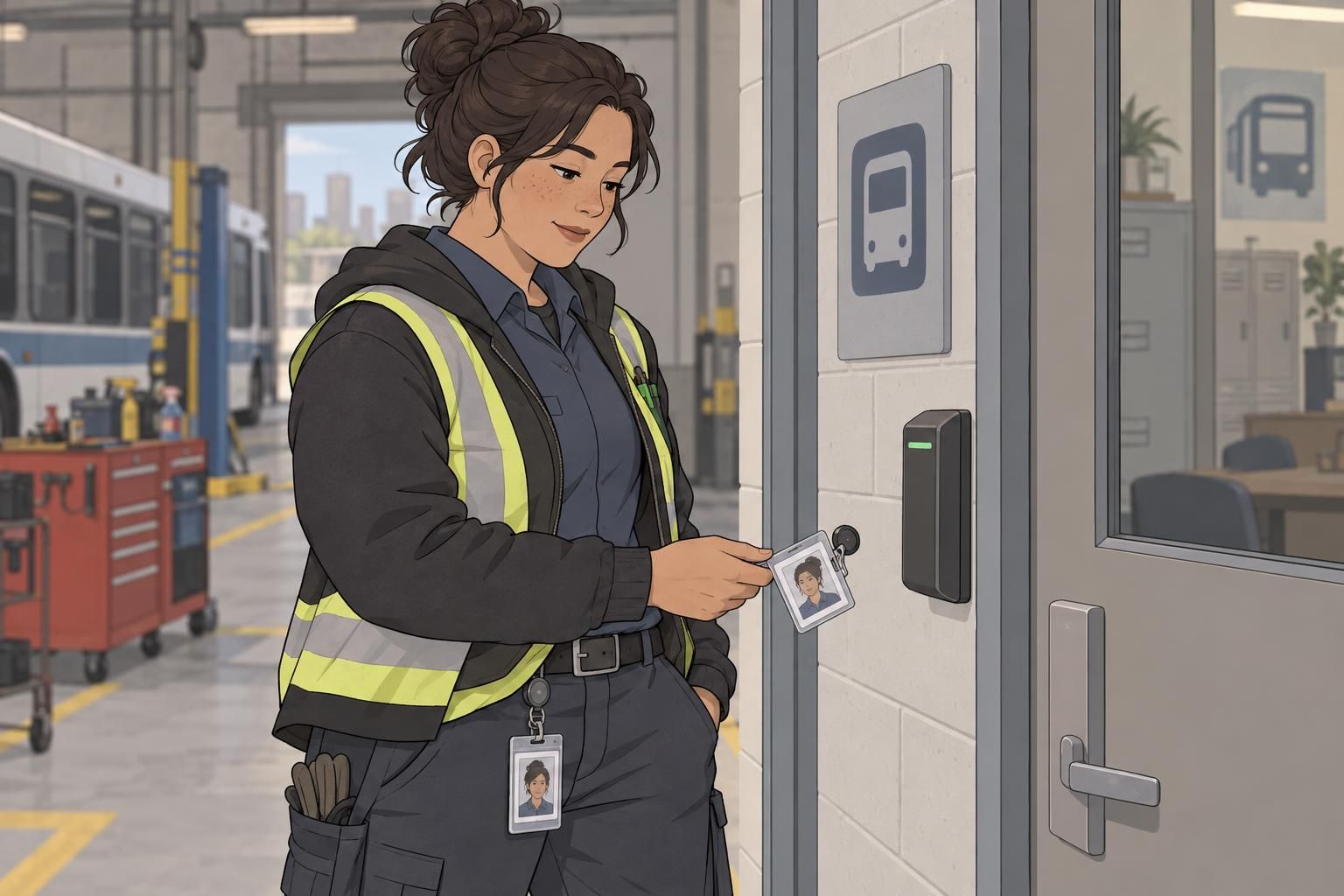
How Scanning Workflows Keep Transportation Moving
Scanning workflows connect a physical credential with a verification process. Depending on the system, a reader may capture information from the card, check its status against an authorized record, or display details for a staff member to review. Visual identity verification can then help establish whether the person presenting the credential matches the person identified by it.
These functions are related, but they are not interchangeable. Reading information successfully does not necessarily confirm that a credential remains valid. Likewise, confirming a credential’s status does not by itself establish that the person holding it is its assigned user. The facility’s process determines which checks are required and how they are completed.
An airport example illustrates the distinction. TSA’s description of credential-authentication technology at JFK explains how the system can scan an ID, check its validity, and compare the traveler’s photo with a live image. This is a traveler identity-checking workflow, not a universal process for employee badges: source.
For workplace credentials, fast scanning ID is a practical design goal rather than a guarantee of identical performance everywhere. Card format, reader compatibility, holder choice, and presentation technique should fit the approved workflow. A card that must be removed or inserted needs a different handling arrangement from one presented while still inside its holder. Procedures and technologies vary by facility and role.
Choosing a Durable Access Card and Holder
A durable access card needs to withstand the worker’s routine, not just look sturdy when new. Repeated handling can wear its surface. Bending can stress the card body, while scratches can obscure printed details. Moisture and friction deserve attention too, especially where a card repeatedly meets a reader slot, holder opening, or attachment point.
Protection should match how the card is presented. A clear protective holder can shield the card from everyday contact while keeping the photo and essential details visible. However, a holder that clouds the photo, grips the card too tightly, or interferes with the approved reader workflow can create unnecessary handling.
- Clear protective holder: Consider this when the badge needs to remain visible and can be presented to the reader without removal. Check visibility and reader performance with the actual holder.
- Clip attachment: Consider this when a worker needs a stable wearing position or frequent access to the card. Inspect the clip and any attachment opening for wear.
- Card-removal workflow: If the reader requires an exposed card, choose an arrangement that permits easy removal and return without repeated bending or force.
- Slot-based workflow: Pay attention to the card edges and surfaces that repeatedly contact the slot. A protective holder helps between uses, but it does not eliminate wear during insertion.
The best pairing supports both protection and presentation. Judge the durable access card and its holder together: how easily can the worker display the photo, reach the reader, and return the badge to its normal position?

Make Badge Details Easy to Read at a Glance
A transportation ID badge should make essential information easy to locate. The photo needs to be clear enough for the required visual comparison, and the surrounding layout should not compete with it. Decorative elements can support a recognizable design, but they should not crowd the details staff rely on during a check.
Strong contrast helps separate information from its background. An uncluttered layout also gives names, roles, and other required details room to remain readable. Making everything larger is not always the answer; prioritizing essential information is often more useful than fitting additional content onto an already busy card.
- Keep the photo unobstructed by the holder edge, clip, or other worn items.
- Place essential details consistently across badges used in the same program.
- Use clear contrast between printed information and its background.
- Check the finished badge inside its holder, not only as an on-screen design.
- Confirm that the badge faces outward and remains visible in its normal wearing position.
Consistency reduces searching. When a checker knows where to find the photo and required information, visual checks become more straightforward. Readability also supports scanning: fewer pauses are needed to turn the badge, move an attachment, or uncover details after the reader captures the credential.

Designing Staff Badges for Everyday Transportation Work
Start with the worker’s routine rather than selecting a badge format in isolation. Where is the reader? How often is the card presented? Does a colleague need to see the photo while the worker wears it? Those questions help connect badge orientation, attachment, and holder choice to actual use.
A chest-level holder may make visual checks convenient, while a belt-mounted arrangement may suit another approved routine. Neither location is automatically best. The attachment must fit the workplace’s requirements and allow the worker to reach the reader without pulling against the card or repeatedly twisting its holder.
Maintenance and depot work also call for attention to contact points. If a badge regularly brushes against clothing, tools, or nearby surfaces, inspect the exposed edges and attachment area. A transportation ID badge that stays readable but develops cracks around its clip still needs attention; reliable everyday use depends on the whole arrangement.
When considering BadgeZoo ID badges for staff identification, keep the printed badge design separate from the facility’s credential approval process. The organization should determine the required information, authorized technology, and wearing rules. A workplace badge remains distinct from an official travel credential, regardless of where the employee works.
Evaluate the badge as a working combination: card, layout, holder, attachment, and reader interaction. A clear design and a suitable holder should make the required checks easier, not change what those checks require.
Maintain, Replace, and Verify Credentials Reliably
Routine inspection helps keep a durable access card useful over time. Before a shift or during an established check, look for fading, cracks, worn edges, a cloudy holder, and loose clips. Notice changes in scanning behavior too. A card that requires repeated attempts should be reported rather than accepted as an unavoidable inconvenience.
- Check that the photo and required details remain clearly visible.
- Inspect the card edges, holder opening, and attachment points for damage.
- Confirm that clips hold securely and the badge stays in its intended position.
- Follow approved care instructions when cleaning the card or holder.
- Report scan problems through the facility’s established support process.
Replacement and updates should follow a controlled process. A new printed card is only one part of restoring a credential: the responsible team also needs to confirm the assigned identity, current details, and required authorization. Old credentials should be handled according to facility procedures so replacement does not leave conflicting cards in circulation.

When an automated reader cannot confirm a credential, staff need a clear manual verification path. That means knowing whom to contact, which identity and authorization checks are required, and how to record or escalate the issue. A visual comparison may support that process, but it should not become an improvised substitute for confirming access permission.
Reliable transportation identification combines quick readability, appropriate protection, and consistent verification. Fast scanning ID works best as part of that complete approach: a well-maintained badge that is easy to present, straightforward to inspect, and supported by a defined process when something goes wrong.