Healthcare Role Badges: Reducing ‘Who Are You?’ Moments in Hospitals and Clinics
Why “Who Are You?” Moments Happen—and How Healthcare Role Badges Help
In hospitals and clinics, people come and go quickly: shift changes, consults, transport, therapies, housekeeping, dietary, techs, trainees, and specialists. For patients and families—especially when they’re stressed, in pain, or sleep-deprived—it’s easy to lose track of who is who. That’s when the “Who are you?” moment happens: a patient looks up and sees a new face, but not a clear role.
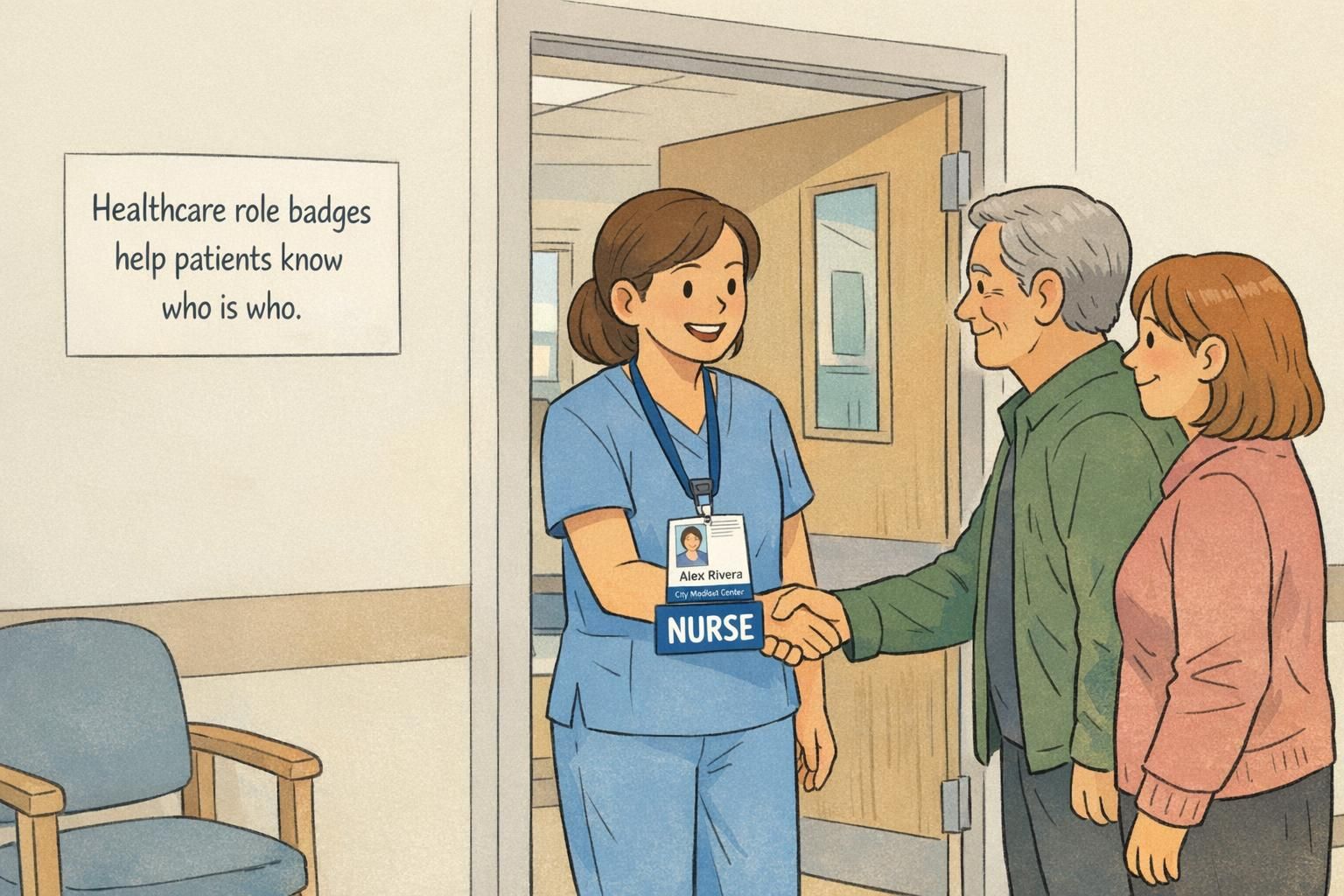
Healthcare role badges are a practical way to make role recognition faster and more consistent. When a role is legible at a glance, patients don’t have to guess whether someone is their nurse, a respiratory therapist, a physician, or support staff. That reduces uncertainty in the room and cuts down on repeated questions that interrupt care.
Role clarity works best when the role is the easiest thing to read, and when the same role looks the same across units and shifts.
The goal isn’t to replace good communication—it’s to reinforce it. A clear, visible role label helps the patient orient immediately, and it helps staff spend less time re-explaining and more time doing the work that brought them there.
The Real Cost of Role Confusion: Anxiety, Interruptions, and Trust Gaps
Role confusion creates friction for everyone. Patients may hesitate to ask questions because they don’t want to “bother the wrong person.” Or they may ask the same question multiple times to multiple staff members because they’re unsure who owns which part of the plan. Families often want to help, but confusion about roles can make it hard to follow instructions, remember updates, or understand the next step.
For clinicians and support teams, frequent “Are you my nurse?” interruptions add up. Even a few seconds of explanation, repeated dozens of times a shift, becomes meaningful time lost—especially during tasks that require focus, sterile technique, or careful documentation. Clear role identifiers reduce the number of times staff must stop to re-orient a patient who is simply trying to feel safe.
Role clarity also supports patient trust. Trust grows when patients feel informed, respected, and included—starting with something as basic as knowing who is speaking to them and why. Research and quality improvement efforts repeatedly emphasize the value of centering patient and carer perspectives when improving care experiences (source). When staff consistently introduce themselves and their roles are clearly visible, it’s easier for patients and carers to engage confidently.
- For patients: less uncertainty, fewer awkward pauses, and clearer expectations
- For families: easier tracking of the care team and the plan of the day
- For staff: fewer interruptions, fewer repeat explanations, and smoother handoffs
- For units: a more predictable, calm experience—especially for new patients
Role Clarity Starts with a Repeatable Introduction (and a Visible Badge to Match)
Even the best badge can’t replace a human introduction. But when introductions are consistent and supported by what the patient can see, the message sticks. A repeatable script sets expectations and reduces follow-up questions later in the shift.
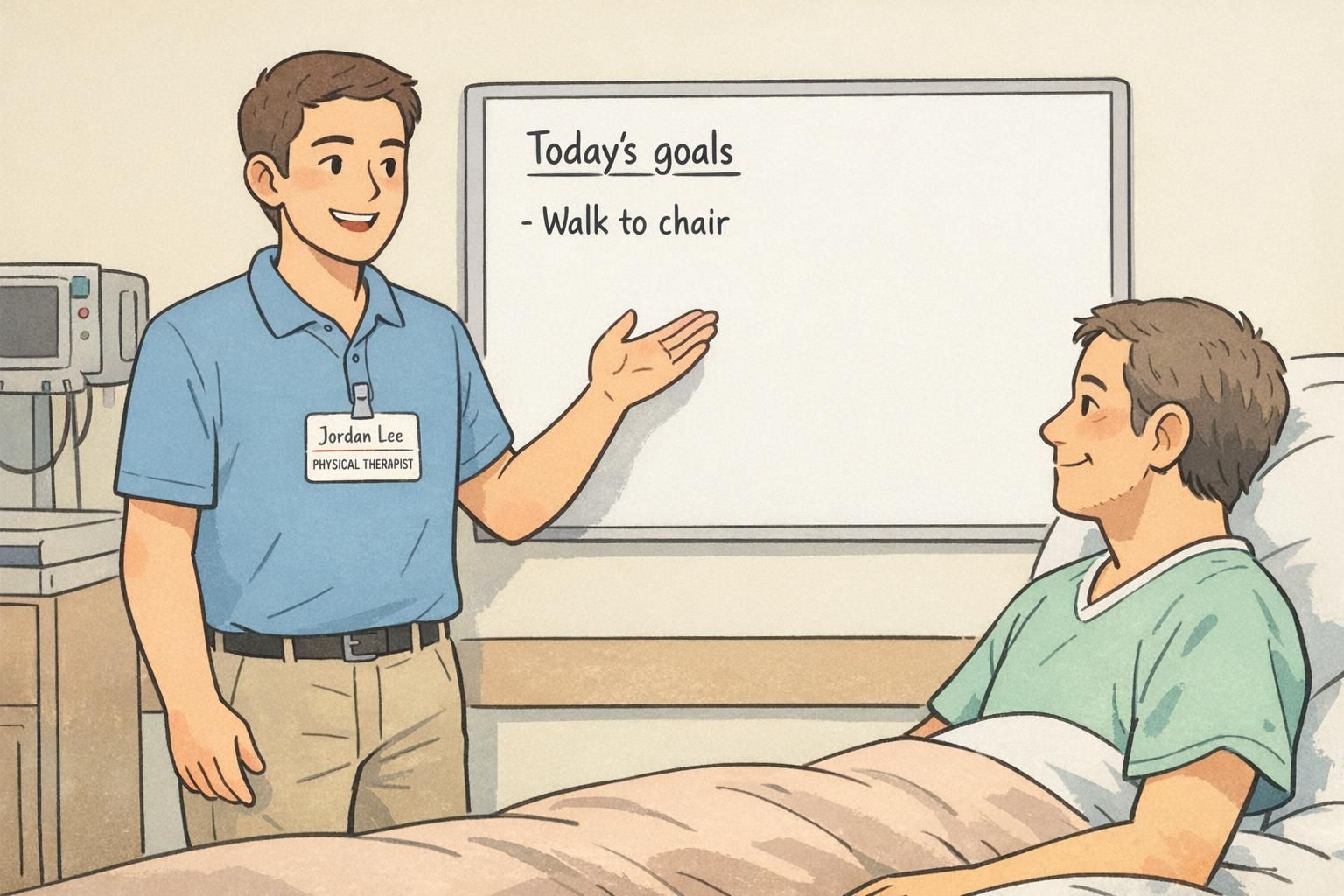
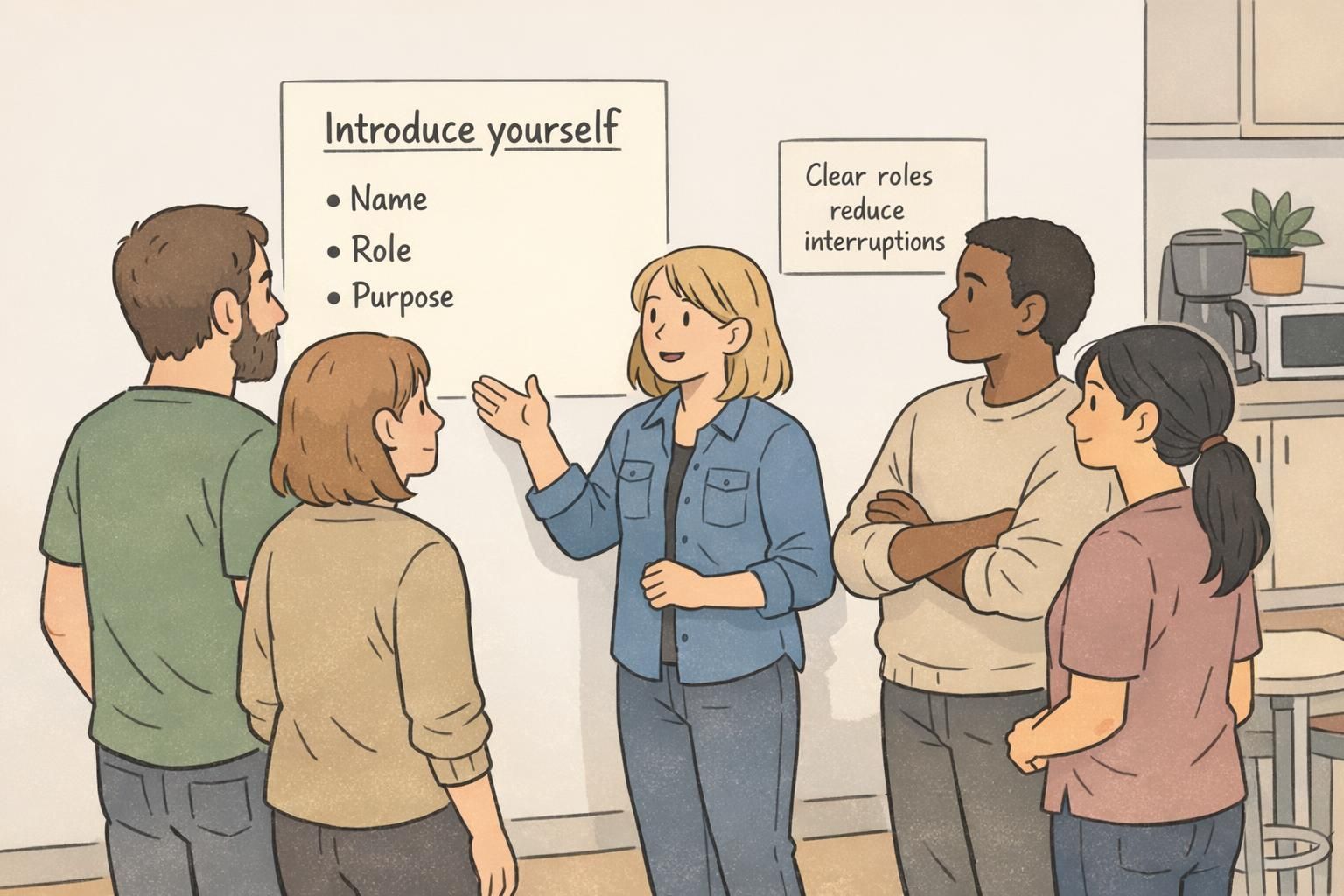
A simple pattern is: name, role, purpose. For example: “Hi, I’m Sam, your Respiratory Therapist. I’m here to check your breathing treatment.” This works because it answers what most patients want to know in the moment: Who is this person? What do they do for my care? Why are they here right now?
Patients remember roles more reliably when the spoken introduction and the visible badge say the same thing, in the same words.
Consistency across units and shifts matters. If one person’s badge emphasizes a title, another uses an acronym, and a third has no visible role at all, patients have to re-learn the system over and over. When a facility uses standardized role labels and staff introduce themselves the same way, patients can build a simple mental map of their care team.
Both matter, but role clarity usually comes first for patient comfort. A quick “I’m Jordan, your Physical Therapist” is often more reassuring than a name alone, because it immediately tells the patient what to expect.
Use multiple cues at once: a clear spoken introduction, large role text, high-contrast printing, and consistent role colors. Repetition helps, but making the role easy to see reduces the need for patients to rely on memory.
Design Principles That Work: Big Role Text and Consistent Colors
If you want to reduce confusion quickly, prioritize what patients are scanning for: the role. Many badges are designed around names, logos, and small-print details. But in a hallway, from a bedside angle, or through the stress of a hospital stay, small role text is easy to miss.
A practical design approach is to make the role the largest, most readable element—often larger than the name. That doesn’t mean the name is unimportant; it means the badge reflects what patients need first to feel oriented.
- Make role text the largest element on the badge (or the most visually dominant)
- Use high contrast (dark text on a light background, or white text on a solid dark color)
- Choose a clean, plain sans-serif font that stays legible at a distance
- Avoid clutter: fewer elements, more readability
- Standardize role wording (e.g., “Respiratory Therapist” instead of rotating between “RT” and “Respiratory”)
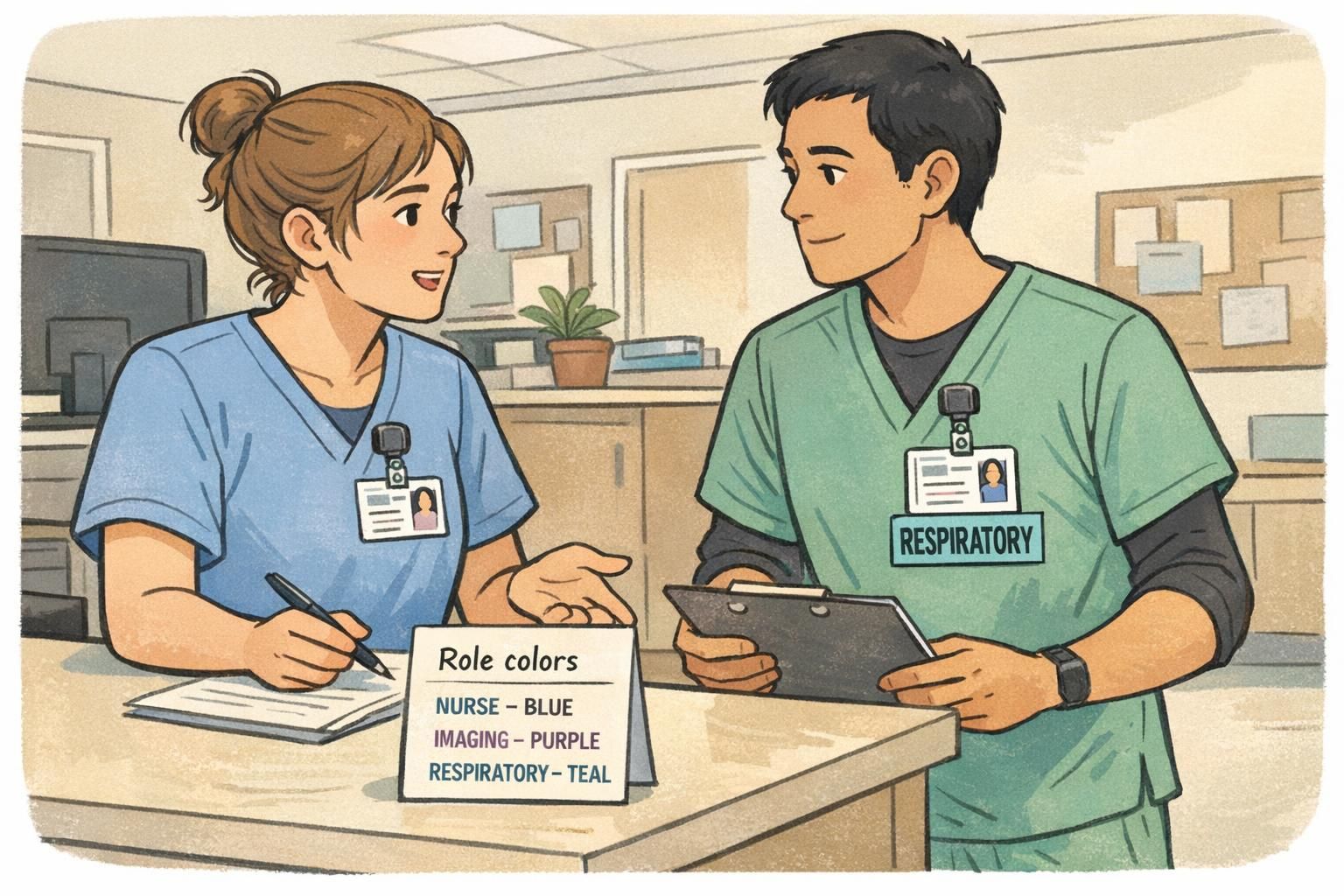
Color cues are the second half of fast recognition. When each role has a consistent color, patients and staff learn the “visual language” quickly: one glance can answer, “This is nursing,” or “This is imaging.” The exact palette matters less than consistency, clarity, and the ability to reproduce colors reliably.
A shared color-and-role standard reduces cognitive load. People stop guessing—and start recognizing.

Where Badge Buddies Fit: Making Roles Legible at a Distance
Even with a well-designed ID, there are situations where role text gets blocked or becomes hard to see: isolation gowns, varying uniform styles, lanyards that flip, or crowded units where people are scanning from several steps away. That’s where badge buddies can help.
Because they sit behind the ID card, badge buddies allow oversized role labeling without replacing required credentials. The role can be bold, high-contrast, and color-coded, while the ID card still carries the facility’s standard elements like photo and name.
- Helpful when staff wear gowns or layers that obscure uniform cues
- Useful in fast-moving areas where coworkers need quick role recognition
- Supports large, readable role text while keeping official ID visible
- Reinforces a standardized color system across departments
“When the role is readable from a few steps away, the conversation starts in the right place. Patients ask better questions because they know who they’re talking to.” – Charge Nurse
Choosing the Right Mix: ID Badges, Name Tags, and Role Add-Ons by Setting
Different spaces create different readability problems. In the ED, interactions may be brief and noisy, with staff moving quickly. In inpatient rooms, patients may be lying down and viewing badges at an angle. In outpatient clinics, the first interaction is often at a front desk where a name tag may be more visible than an ID card on a lanyard.
A good system aims for predictable placement, easy scanning, and minimal ambiguity—while still fitting facility policy and infection control practices. The “right” mix often depends on how close patients typically are when they interact, and whether uniforms already provide consistent cues.
- ED and procedural areas: prioritize fast scanning from a distance (large role text, high contrast, consistent colors)
- Inpatient units: prioritize readability at bedside angles (stable placement and uncluttered layouts)
- Outpatient clinics: prioritize clear role cues at check-in (front desk name tags and clinician ID badges that don’t flip)
- Support services: prioritize quick identification for patient comfort and coordination (consistent role colors across departments)
Some teams do well with a large name tag that includes role. Others prefer an ID badge plus a role add-on so the official credential remains unchanged while role clarity improves. The key is to choose a format staff will actually wear consistently, in a place patients naturally look.

Implementation Checklist: Standardize, Train, and Keep It Consistent
Role clarity only works when it’s consistent. If color meanings vary by unit, if roles are labeled inconsistently, or if badges are frequently missing, patients and coworkers can’t learn the system. A strong rollout focuses on standardization, simple training, and an easy way to maintain the program over time.
- Define a role list: decide which roles need clear, patient-facing identifiers
- Choose standardized role wording: avoid switching between acronyms and full titles
- Assign consistent colors by role and publish a simple reference
- Set layout rules: role text size, contrast, and uncluttered design
- Train a short introduction script (name, role, purpose) that matches the badge
- Build operational steps: onboarding issuance, replacements, and where staff go with questions
- Monitor feedback: track common “Who are you?” questions and patient comments before and after rollout
The biggest wins often come from the simplest changes: standard role words, large text, consistent colors, and a repeatable introduction.
Product Corner: Role-Focused Identification Tools for Clearer Patient Interactions
When the goal is faster role recognition, look for identification tools that prioritize big, high-contrast role text and a consistent color system across teams. Many facilities already have required ID credentials; role add-ons can complement those requirements while improving at-a-glance clarity for patients, visitors, and coworkers.
If you’re exploring role add-ons, consider options designed to sit neatly with an existing ID card so the credential stays visible and the role remains easy to read. For example, you can standardize colors and oversized role labels across units using color-coded badge buddies with large role text.
Operationally, it helps when replacement and expansion are straightforward—especially during hiring waves or when a department updates role naming. BadgeZoo supports no minimum order quantity, which can be useful if a unit wants to pilot a role system before scaling it more broadly.
The most effective tools are the ones staff will wear consistently and patients can interpret instantly—role first, readable fast, and aligned with how introductions happen in real rooms.