
ID Badge Questions: Design and Specifications
The most useful ID badge questions start with everyday use: who needs to recognize the wearer, what information they need, and where the badge will be worn. These 25 answers cover design, accessories, technology, security, and purchasing so you can prepare clear specifications before production begins.
Start with these ID badge questions
1. What size and orientation should an ID badge be?
Choose dimensions around the information, attachment, and intended use—not appearance alone. Portrait layouts may suit vertically arranged details, while landscape layouts offer a wider reading area. Confirm the finished dimensions with your supplier and check that the badge fits any existing holder, printer, or reader.
2. Which details belong on the badge?
Start with the wearer's name, organization, and role or department where useful. Give the most important information the strongest visual emphasis. Include employee numbers or other identifiers only when they serve a defined purpose, and avoid displaying personal information that viewers do not need.
3. Should every badge include a photograph?
A photo is useful when staff need to compare the badge with its wearer. Other settings may prioritize a readable name and role. Decide according to your identification procedures, then establish consistent photo framing and image-quality requirements so pictures remain recognizable at the final printed size.
4. Can an existing badge design be reused?
Ask the producer to review your existing artwork before assuming it is production-ready. Confirm dimensions, image quality, fonts, colors, and variable-data fields. Reusing a familiar design can support consistency, but changes may be needed for a different card format, attachment location, or technology.
5. What should we check on the proof?
Review names, titles, photos, logos, alignment, and front-to-back orientation. View the layout at actual size to judge readability. Confirm that holes, clips, and holders will not obscure information. Approve the proof in writing, and distinguish visual approval from any separate technology testing.

Accessories and Badge Buddies
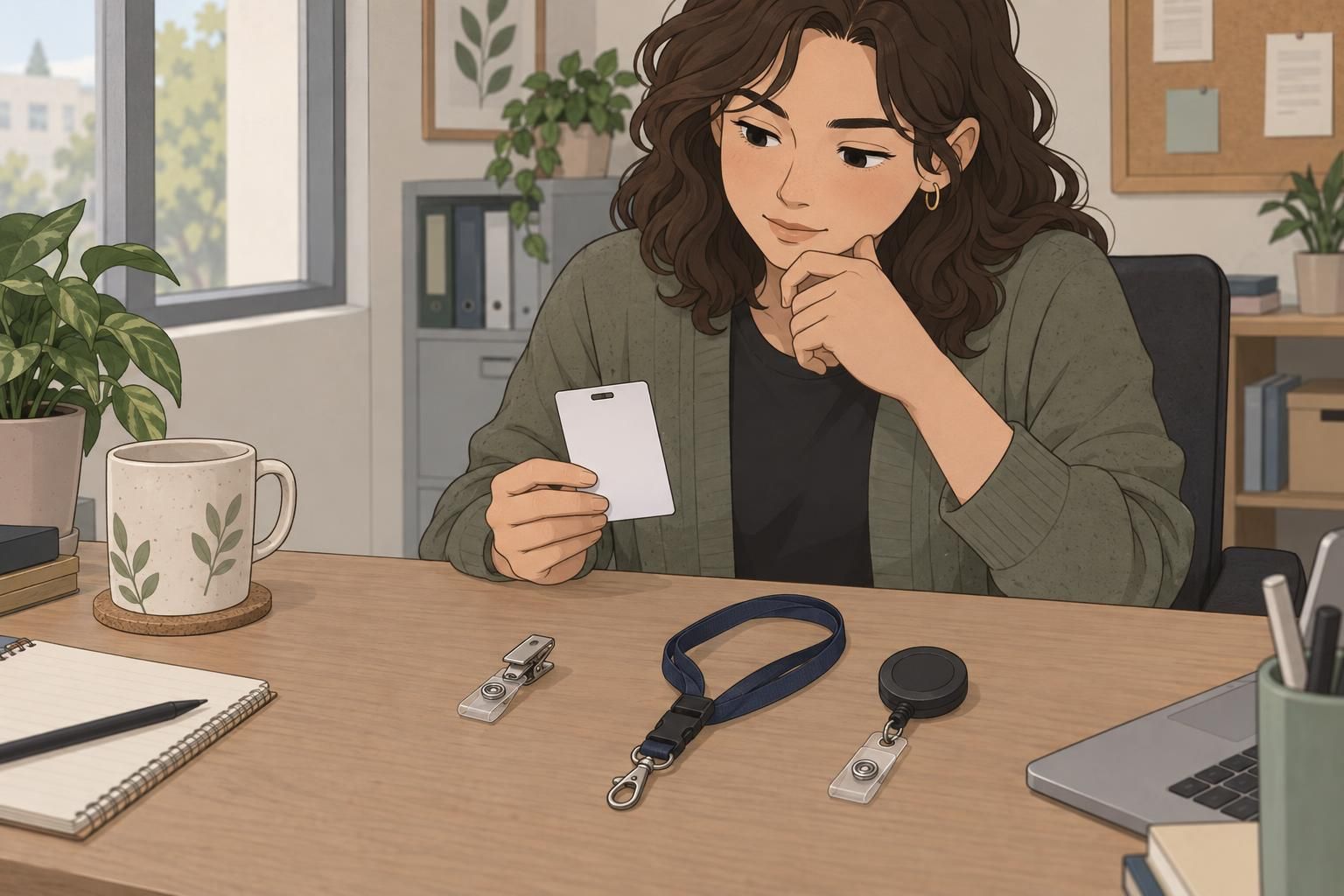
An attachment should keep identification visible without making it uncomfortable or awkward to use. Evaluate the complete setup—badge, holder, attachment, and any role label—rather than choosing each component separately.
6. How do we choose between clips, lanyards, reels, and magnetic backs?
Match the attachment to clothing, movement, and workplace rules. Clips attach directly to suitable garments; lanyards suspend badges; retractable reels let wearers extend credentials toward readers. Magnetic backs may suit some clothing and environments, but confirm applicable restrictions and whether the attachment supports the badge securely.
7. Do holders and attachments need to match badge orientation?
Yes. Check holder dimensions, slot or hole placement, and whether the badge hangs straight in its intended orientation. Test the assembled setup while sitting, walking, and presenting it to a reader. A holder should protect the badge without hiding names, photos, codes, or required markings.
8. What is a badge buddy, and when is it useful?
A badge buddy sits behind or alongside an ID badge to display a prominent role or department label. It can help people identify the right staff member quickly. BadgeZoo's badge buddies are relevant to this setup; confirm that the role label remains visible beneath the main badge and holder.
Badge Technology and Existing Access Systems
Separate visual identification from electronic access when writing specifications. A badge can support either function or both, but its printed appearance does not establish compatibility with an access system.
9. Do all ID badges use RFID?
No. Some badges provide visual identification only. Others use RFID, barcodes, QR codes, magnetic stripes, or another technology. Choose according to the task the credential must perform, rather than adding technology without a defined workflow.
10. How do we confirm compatibility with existing readers?
Have your access-system administrator identify the exact credential specifications accepted by your readers and software. Share those requirements with the supplier, including encoding and enrollment needs. Test a representative sample on the actual system before authorizing the production run; a general technology label is not enough.
11. Can existing card numbers be retained?
Sometimes, but confirm what 'card number' means in your system. A printed identifier may differ from the number read electronically. Ask the administrator and producer which values can be preserved, how replacements will be enrolled, and how duplicate or conflicting credentials will be prevented.
12. Can one badge provide identification and access?
Yes, when the design and credential technology meet both needs. Keep names and photos readable while preserving the usable areas required by codes or other features. Test scanning, reader performance, and enrollment. A readable QR code or barcode alone does not establish a person's access authorization.

In-House Printing or Outsourced Production?
Both approaches can work. Compare the full issuance process, including staff time and ongoing support, rather than considering only the price of a blank card or printed badge.
13. When does printing badges in-house make sense?
In-house printing may fit organizations that issue credentials frequently or need immediate replacements. Account for printers, software, supplies, maintenance, training, and secure data handling. Also identify who will troubleshoot problems and how badges will be issued if equipment is unavailable.
14. When is outsourced production practical?
Outsourcing may suit planned batches, occasional issuance, or organizations that prefer not to maintain printing equipment. Compare preparation time, proofing, production, shipping, and replacement arrangements. A combined approach can also be considered, provided preprinted cards and on-site personalization equipment are confirmed compatible.
Security, Privacy, and Badge Lifecycle Questions
Security-related ID badge questions need written procedures as well as product specifications. The Salt Lake City International Airport badging FAQ offers a real-world reference for credential controls: source. Use it as context, not as a substitute for your organization's applicable policies or requirements.
15. How should photos and personal data be submitted?
Agree on an approved secure transfer method before sending files. Limit submissions to required information and restrict access to authorized personnel. Confirm who receives the data, how corrections are handled, and when working files will be deleted or retained under applicable requirements.
16. Which security features should buyers request?
Ask which visual and electronic features are available and how each supports your verification process. Staff may need to compare the wearer with a photo, inspect required markings, and confirm current authorization electronically. No single printed feature replaces appropriate issuance checks and access controls.
17. Should badges have expiration dates?
Use expiration dates when they support your credential policy, particularly for time-limited roles or visits. Decide whether expiration is printed, managed electronically, or both. Assign responsibility for renewals, and ensure a printed date is not mistaken for proof that electronic access remains active.
18. What should happen when a badge is lost or stolen?
Provide a clear reporting route and require prompt reporting under your policy. Authorized staff should deactivate applicable access privileges, record the incident, and verify identity before issuing a replacement. If the original badge is recovered, follow a defined procedure rather than automatically returning it to use.
19. How should temporary credentials be controlled?
Define who may authorize temporary credentials, what access they permit, and when they expire or must be returned. Record who received each credential and verify identity appropriately. Make temporary status understandable to staff without exposing unnecessary personal information.
20. What records should be kept throughout the badge lifecycle?
Track issuance, assigned identifiers, access authorization, expiration, replacement, return, and deactivation as appropriate. Limit record access and follow applicable privacy and retention requirements. Establish how returned cards, obsolete credentials, photos, and production files will be securely handled when no longer needed.

Badge Ordering Help: Quantity, Quotes, and Timelines
Good badge ordering help turns a general request into a documented production plan. An ID badge FAQ should help buyers resolve requirements before production, not leave critical decisions until delivery.
21. How many badges should we order?
Count current users, expected hires, planned visitors or events, and likely replacements. Add a reasonable reserve based on your issuance history and reorder lead time. Distinguish personalized badges from blank reserve stock, since an already personalized spare may not suit a different wearer.
22. What should an itemized quote include?
Request separate costs for badges, personalization, technology or encoding, accessories, setup, samples, packaging, and shipping where applicable. Confirm quantities and specifications behind each price. BadgeZoo has no minimum order quantity, which can help when planning small batches or replacements.
23. How should we plan the delivery schedule?
Request a written schedule separating data preparation, proof approval, sample testing, production, inspection, and shipping. Identify who approves each stage and when complete information is due. Distinguish the shipping date from the arrival date, and allow time to inspect and distribute badges before use.
Reorders and a Practical Buyer Checklist
Resolving ID badge questions once is useful; documenting the answers makes future orders more consistent. Keep a controlled specification record so a change in staff or supplier does not leave the next buyer guessing.
24. What should we confirm about future reorders?
Confirm how approved artwork, dimensions, materials, finishes, technology, numbering, and packaging instructions will be identified for reuse. Ask which order records the supplier retains and for how long. Keep your own approved specifications, and review changes before assuming a reorder will match earlier batches.
25. What belongs on the final buyer checklist?
Use the checklist below before approval. Assign an owner to each item and record unresolved questions. A complete order should connect the badge's purpose with its design, technical requirements, delivery plan, and lifecycle procedures—not simply confirm that the artwork looks correct.

- Define the badge's purpose, users, and required information.
- Confirm dimensions, orientation, attachment, and wearer comfort.
- Verify technology compatibility with the system administrator.
- Agree on secure photo and data transfer.
- Approve the proof and test representative samples.
- Confirm itemized pricing, quantities, and packaging.
- Document production, inspection, shipping, and delivery dates.
- Set procedures for issuance, tracking, expiration, loss, deactivation, replacement, and records retention.
The best badge specification is one your team can use, verify, and reorder confidently. Resolve design, technology, and credential-control questions together before production begins.