Why a Shift Work Badge System Matters for Quick Change Staff
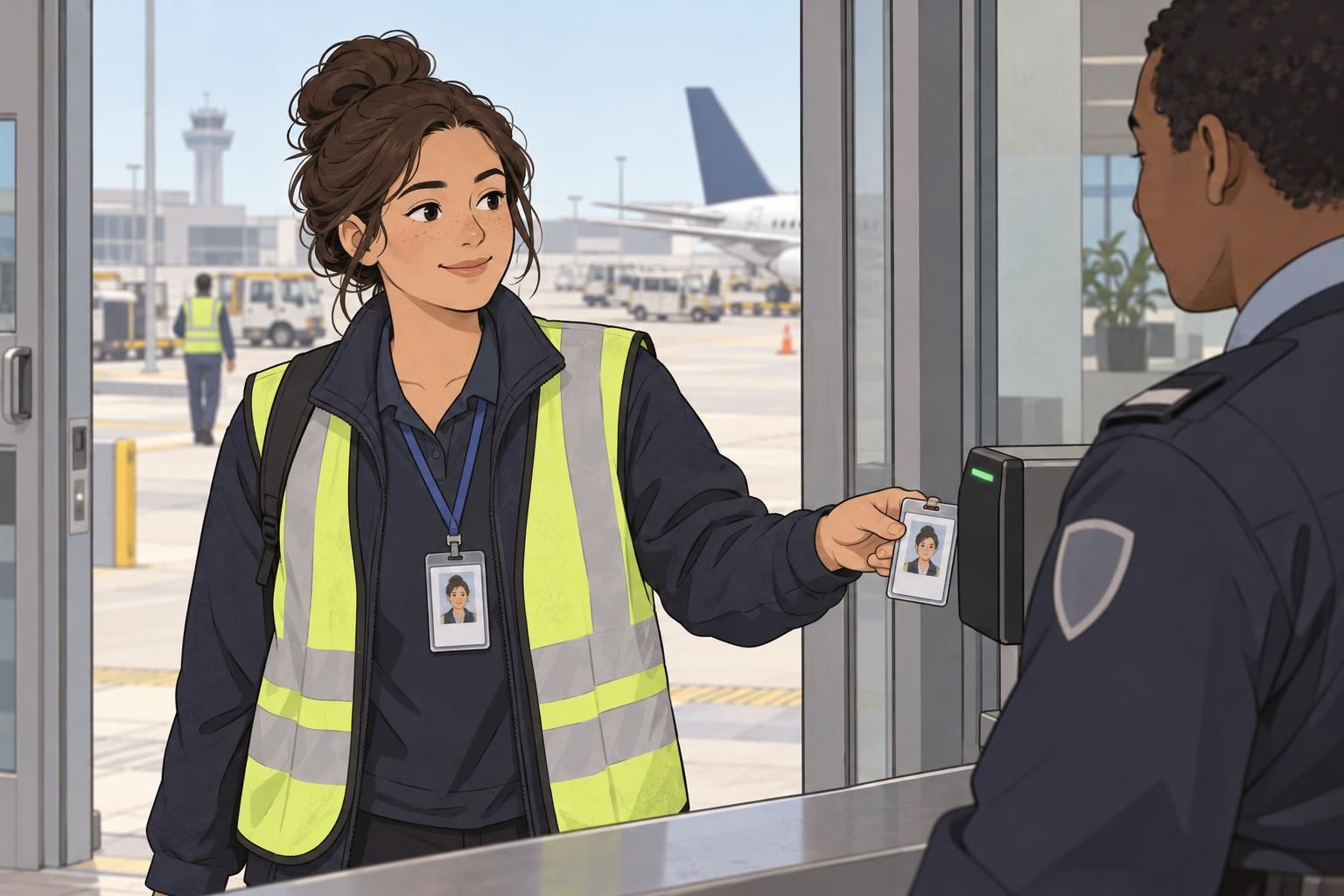
When teams rotate quickly—between stations, roles, or access points—identification can either keep work flowing or become a repeated bottleneck. A solid shift work badge system is designed for speed: staff should be able to pick up the correct ID, attach it the same way every time, and move on without asking questions or hunting for parts.
For quick change staff, the goal isn’t a “perfect” setup—it’s a predictable one. Predictability means doors and checkpoints stay moving, customers or patients see clear identification at a glance, and supervisors spend less time troubleshooting badge handoffs.
- Predictable access: every role has a consistent place and a consistent attachment method
- Clear identification: badges face forward and remain readable during motion
- Fewer interruptions: less time spent searching for clips, holders, or compatible parts
- Lower loss rate: fewer loose components floating between pockets, counters, and lockers
A shift work badge setup works best when it’s built around repeatable steps: grab the right kit, attach it the same way, verify it’s readable, and go.
Common Swap Problems (and What They Cost You)
Frequent swaps can turn small accessory issues into daily friction. If staff are swapping IDs several times a day, even a 20-second delay becomes a noticeable drain—especially at shift change when lines form and everyone feels rushed.
The most common problems tend to be simple: missing clips, cracked holders, unlabeled spares, and inconsistent attachment types (a card with holes but a holder with only a slot, or vice versa). The hidden cost is the confusion these issues create at doors, checkpoints, and service counters—places where hesitation is amplified.
- Missing parts: reels, clips, or holders “borrowed” from other kits and never returned
- Mismatched hardware: attachments that don’t fit the card format used on that shift
- Unreadable presentation: badges that flip backward or tuck under clothing
- Rushed handoffs: staff walk away with the wrong role ID or without required add-ons
- Hygiene concerns: shared lanyards or accessories passed hand-to-hand without a simple wipe routine
"If the holder or clip isn’t exactly what someone expects, they’ll improvise—pocket it, pin it, or ask a supervisor. The best swap systems remove the need to improvise." – Shift Lead
Choosing a Quick Swap Badge Holder: What to Look For
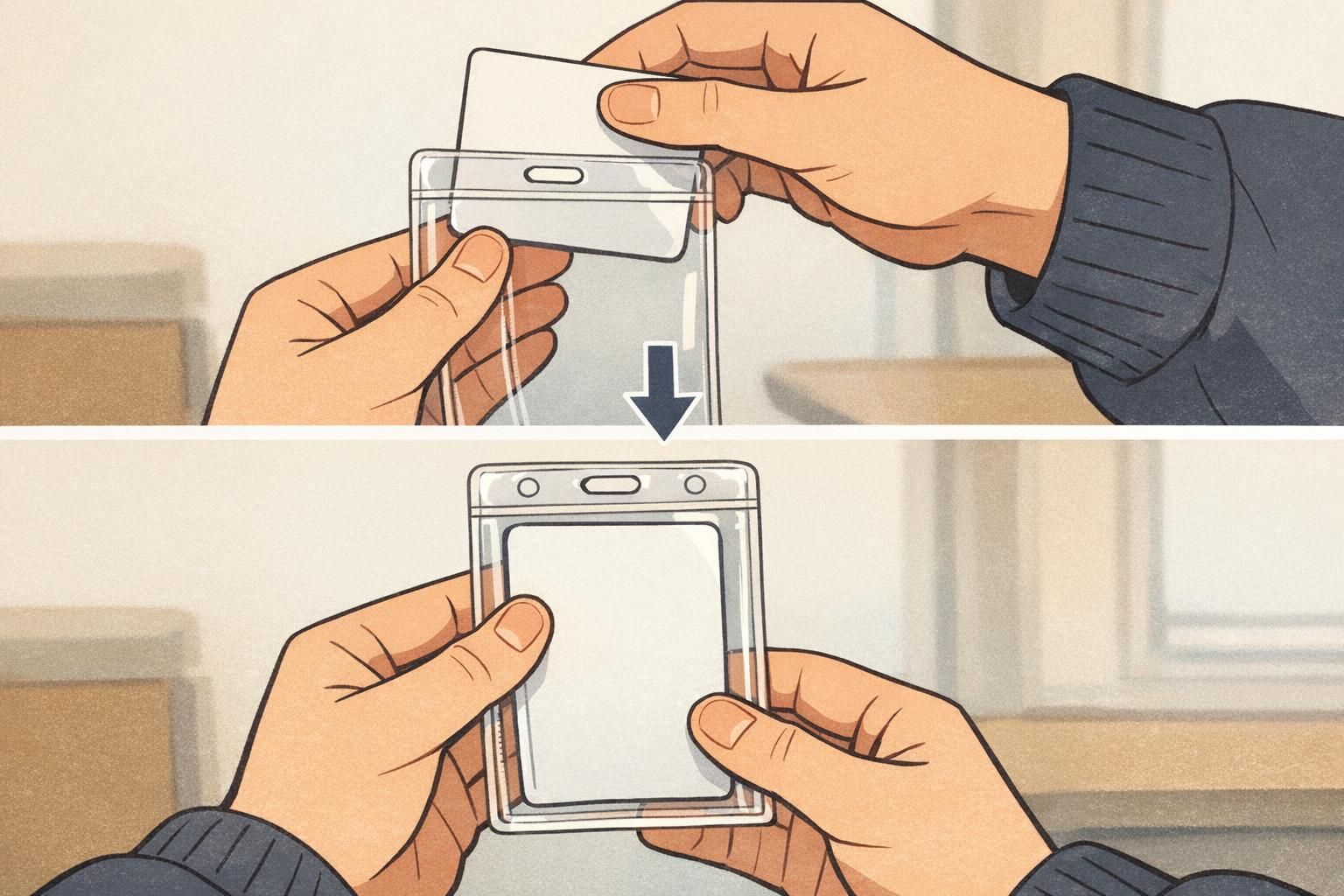
A quick swap badge holder should make the card change the easiest part of the handoff. The right holder lets staff insert and remove the card quickly without bending, without tools, and without needing a clean table surface to “work on it.” If your team wears gloves or frequently has wet hands, the holder needs to open and load smoothly under less-than-ideal conditions.
Standardizing on a single quick swap badge holder model is one of the fastest ways to reduce downtime. When every station uses the same holder style, staff don’t have to think about compatibility—only the role they’re picking up.
- Fast insert/removal: the card slides in and out without catching or warping
- Durable material: a rigid, crack-resistant plastic that holds up to frequent handling
- Dependable attachment point: a strong slot and/or hole options if your card formats vary
- Forward-facing design: helps the badge stay visible and readable while moving
- Simple edges and surfaces: easier to wipe down and less likely to collect grime
Should we choose vertical or horizontal holders for quick swaps?
Choose the orientation that matches how people need to read the badge most often. Vertical holders are common for chest-level wear and can keep the badge from rotating, but the best choice is the one your team can load quickly and wear consistently.
What if our cards aren’t all the same format?
Start by standardizing one card size and punch style where possible. If formats must vary, prioritize holders and attachments that support both slot and hole compatibility so staff aren’t stuck with a holder that can’t be used on the next shift.
Clean, Personal-Worn vs Shared Components: A Simple Hygiene Plan
In workplaces with lots of role rotation, hygiene and practicality often pull in different directions: sharing accessories makes swaps fast, but personal-worn items reduce unnecessary contact. A simple plan is to assign each person a personal-worn component (such as a lanyard or retractable reel) while the ID card and role identifiers are what change per shift or per role.
This approach reduces the amount of “shared touch” on items that contact clothing and skin, while still supporting fast handoffs. It also makes cleaning routines straightforward, because fewer components need to be sanitized between users. General hygiene guidance emphasizes consistent hand hygiene and cleaning routines in shared settings; keeping a simple, repeatable process helps teams follow it reliably. See source.
- Personal-worn: lanyard or retractable reel assigned to one person
- Shared by role: the ID card and any role identifiers kept in a labeled kit
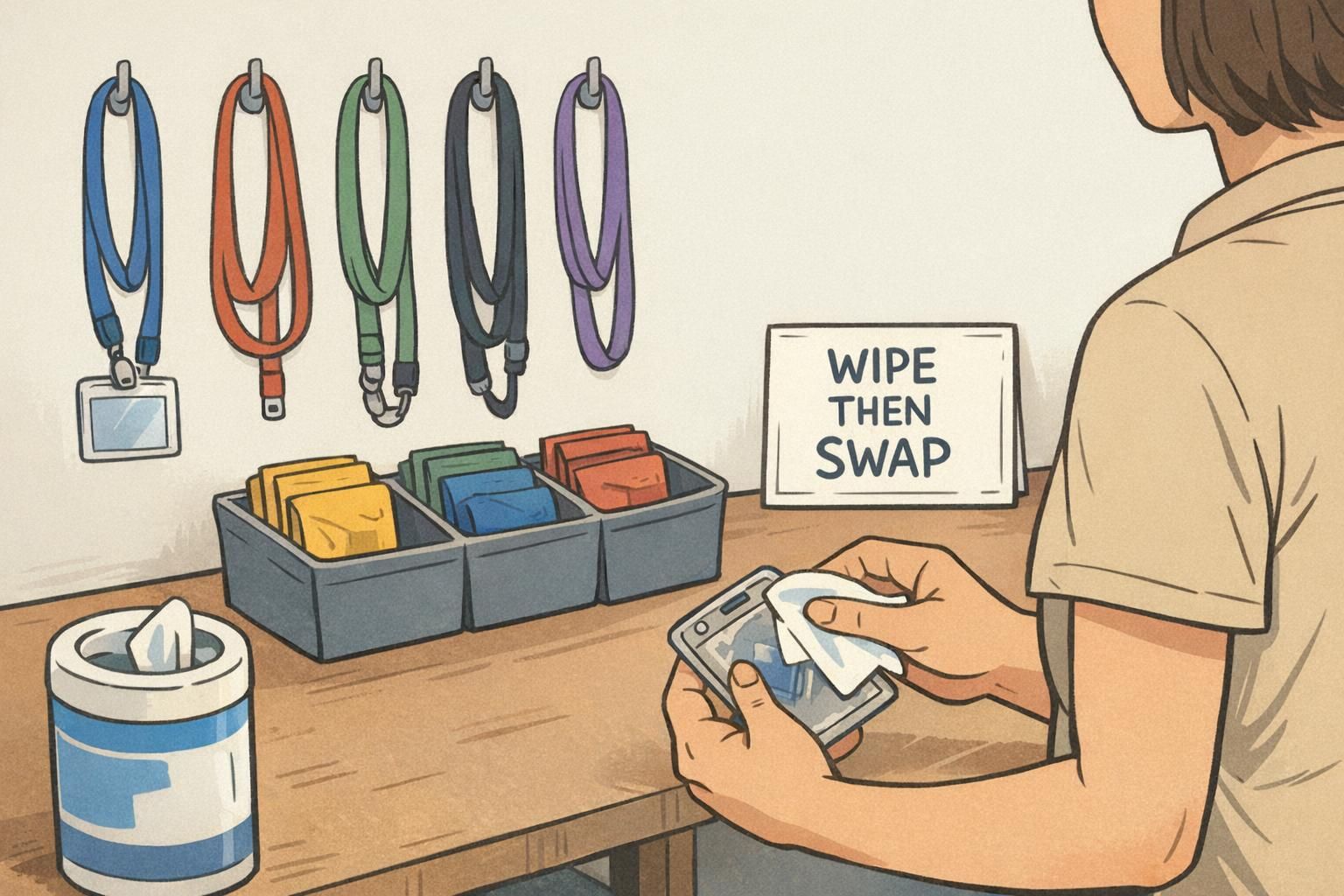
- At the swap point: approved wipes placed next to the kits
- Routine: wipe the shared pieces, swap the card, confirm it’s facing forward, then go
If staff are in a hurry, the hygiene plan has to be frictionless. A “wipe, swap, go” routine only works when the wipes and the kits are exactly where the swap happens.
Fast Handoff Stations: Where Badge Swaps Actually Happen
Most badge problems aren’t caused by the badge—they’re caused by where the swap happens. If people are exchanging IDs in hallways, over sinks, or at crowded counters, parts get dropped, kits get mixed, and badges get left behind. A designated handoff station keeps the process contained and repeatable.
Place the station where shift changes naturally occur: near the time clock, outside the breakroom, or at a supervisor desk. The station should be well-lit, uncluttered, and easy to sanitize. When shared badge accessories are involved, a fixed station is what prevents “temporary” placements that become permanent losses.
- One clearly marked spot for role kits (bin, tray, or small drawer system)
- Labeled hooks or pegs for personal-worn lanyards/reels (if applicable)
- A short posted checklist: wipe, swap, verify, return the old kit
- A simple rule: badges don’t go on sinks, food counters, or open ledges
"Once we put the swap point in the same place every day, the ‘mystery missing badge’ problem almost disappeared. People stopped setting things down wherever." – Operations Coordinator
Role Kits for Shared Roles: Pre-Built Sets That Reduce Lost Parts
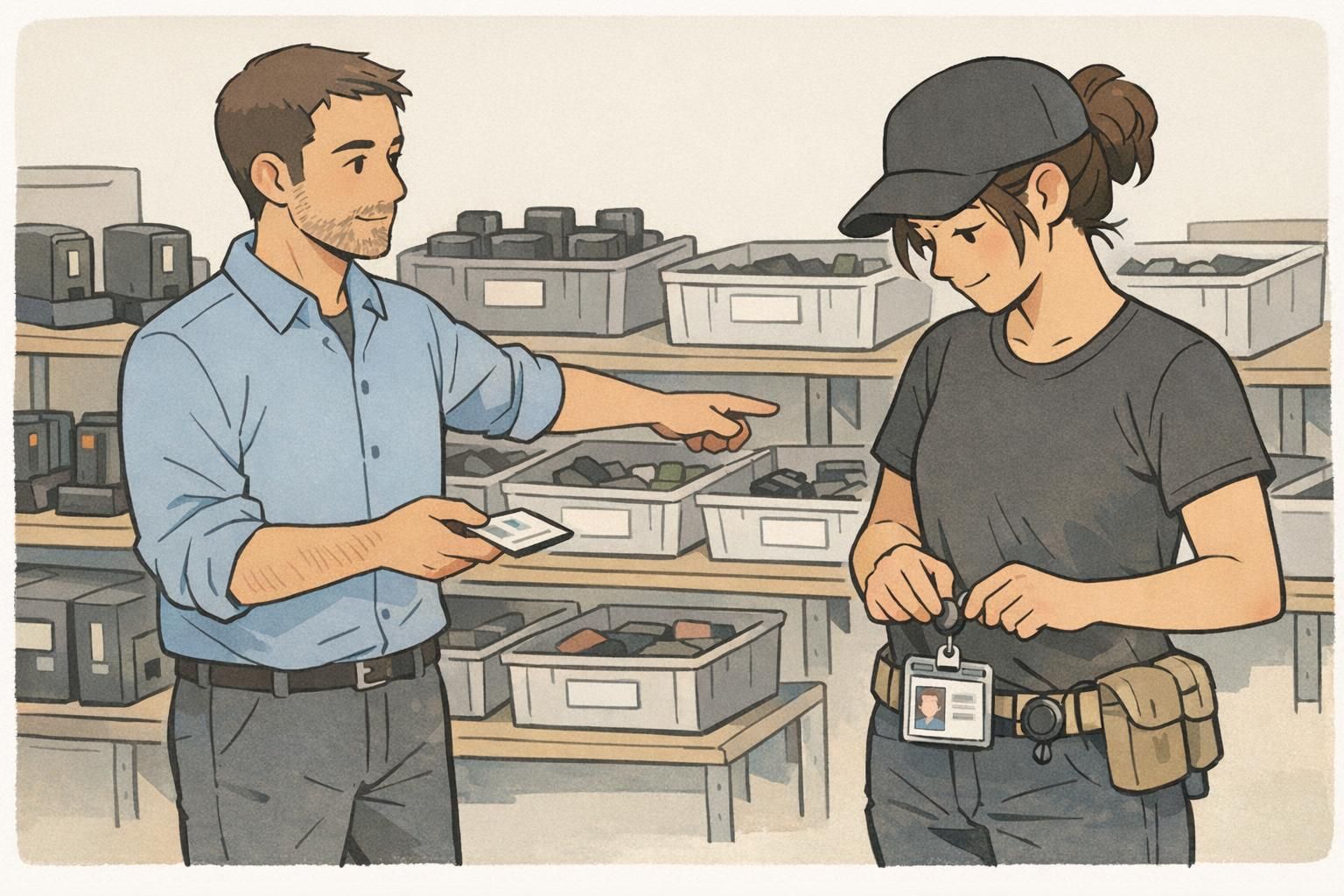
If roles are shared, the most reliable method is a pre-built “role kit.” The kit stays together, returns to the same storage spot, and includes everything needed for that role—so staff don’t have to borrow parts from other kits. This is where standardization pays off: the same holder type, the same attachment approach, and consistent labeling.
Role kits are especially helpful for floating staff and high-turnover patterns, because the system doesn’t rely on tribal knowledge. A new team member can follow the labels, grab the kit, and wear it correctly without improvising.
- Include in each kit: ID card + matching holder + required attachment hardware
- Store as one unit: don’t separate the card from the holder unless your process requires it
- Use color-coding carefully: one color per role group to reduce mis-grabs
- Separate access levels: physically separate kits if access differs by role
- Make returns easy: the “home” for each kit should be obvious and labeled
If you want fewer missing pieces, eliminate scavenging. A role kit should never require someone to borrow a clip or reel from another role to make it wearable.
When to Use Badge Buddies or Extra Identifiers (Without Slowing Swaps)
Some environments need role clarity as much as they need identity verification. When it matters that someone is “FLOAT,” “CHARGE,” or “SECURITY” at a glance, extra identifiers can prevent repeated questions and reduce misdirection during busy moments.
Badge buddies (rigid backing cards) work well when they’re treated as part of the kit rather than an optional add-on. The key is to keep the stack aligned and rigid so it clips together quickly and doesn’t turn the swap into a fumbling session. Limit variations to what the team truly needs so staff aren’t deciding between multiple near-identical options during handoff.
- Use a badge buddy when role visibility must be immediate from several feet away
- Keep the stack simple: one ID badge + one role identifier, clipped together as a straight vertical set
- Avoid over-variations: too many role labels slow decisions and increase mix-ups
- Store with the role kit so the identifier never “walks away” on its own

Will adding a role identifier slow down the swap?
It can, unless it’s standardized. If the role identifier is always stored with the kit and clips on as a single aligned stack, most teams find it adds clarity without adding meaningful time.
Do we need role identifiers for every role?
Not necessarily. Use them where instant role recognition prevents confusion or interruptions. Keeping the number of role labels limited often improves speed and reduces errors.
Products That Fit Quick-Change Workflows (Holders, Name Tags, and Role Add-Ons)
Quick-change teams usually do best when badge formats are consistent: the same card size, the same punch style, and accessories that attach the same way across shifts. That consistency helps staff swap confidently even when they’re new to the role or stepping in temporarily.
BadgeZoo can support these workflows with durable ID badges, standardized holders, and role-based backing cards that make roles obvious at a glance. If your setup benefits from role visibility, you can explore custom badge buddies for quick role identification while keeping the swap process simple and uniform.
If you’re building role kits, it also helps to choose consistent attachment slots (for example, using the same slot or hole style across cards) so shared badge accessories don’t become a compatibility puzzle during a rushed handoff.
A quick-change system isn’t about having more accessories—it’s about having fewer types of accessories, used the same way every time.
Implementation Checklist: Faster Swaps, Fewer Missing Pieces
The fastest improvements usually come from standardization and a clear “home” for every component. Start with one holder style, decide what stays personal-worn versus shared, and then build role kits that can survive a busy week without turning into a pile of mixed parts.
- Standardize one holder style and one attachment method wherever possible
- Confirm card compatibility: slot and/or hole formats match your chosen attachments
- Decide what’s personal-worn (lanyard/reel) vs shared (role card/identifier)
- Build role kits that stay together: ID card + holder + required add-ons
- Create a single swap station in the natural handoff location
- Post a short routine: wipe shared parts, swap, verify visibility, return old kit
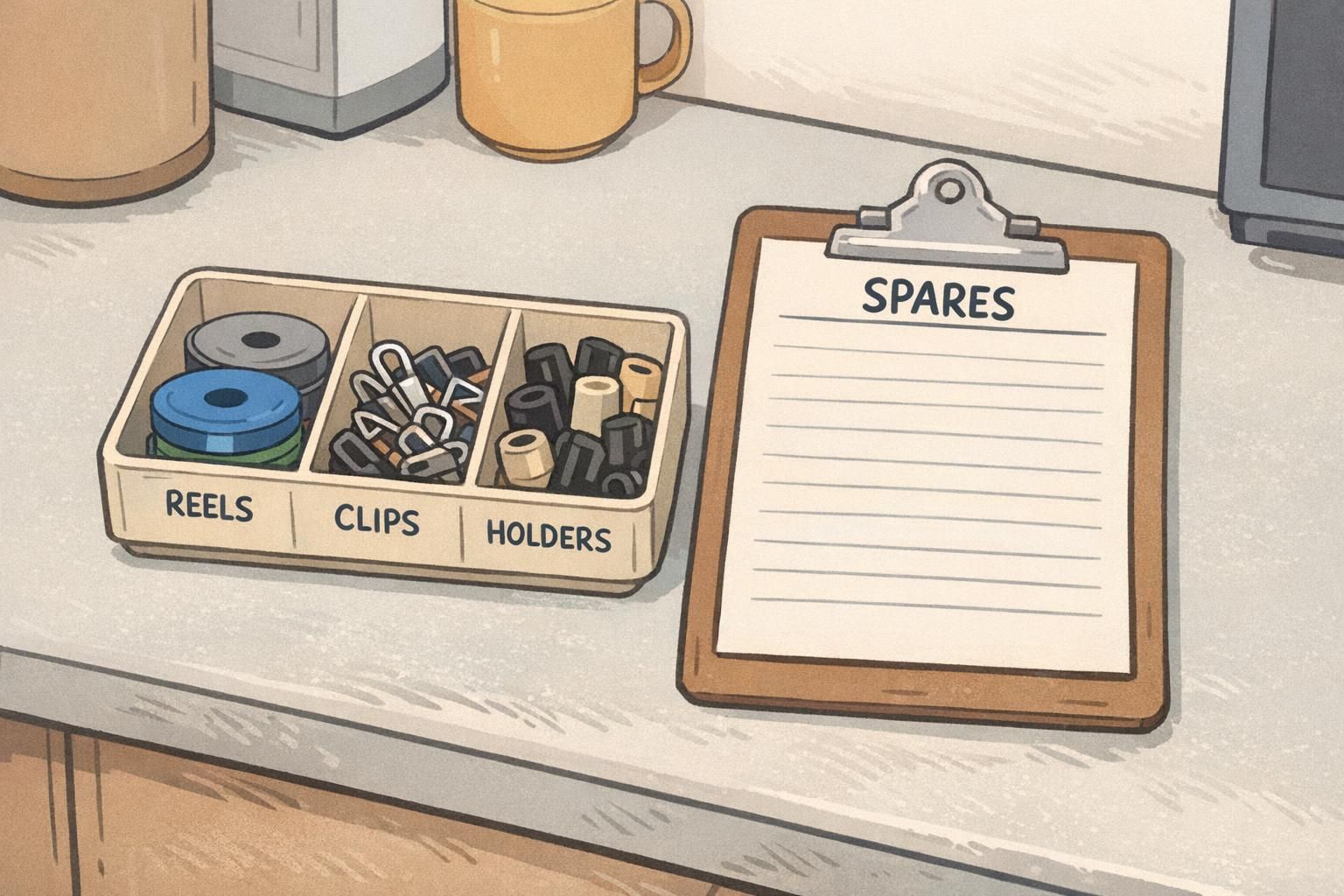
- Stock a small “spares” bin: extra clips, spare holders, and backup attachments
- Track failure points weekly: broken clips, unreadable cards, missing reels, lost kits
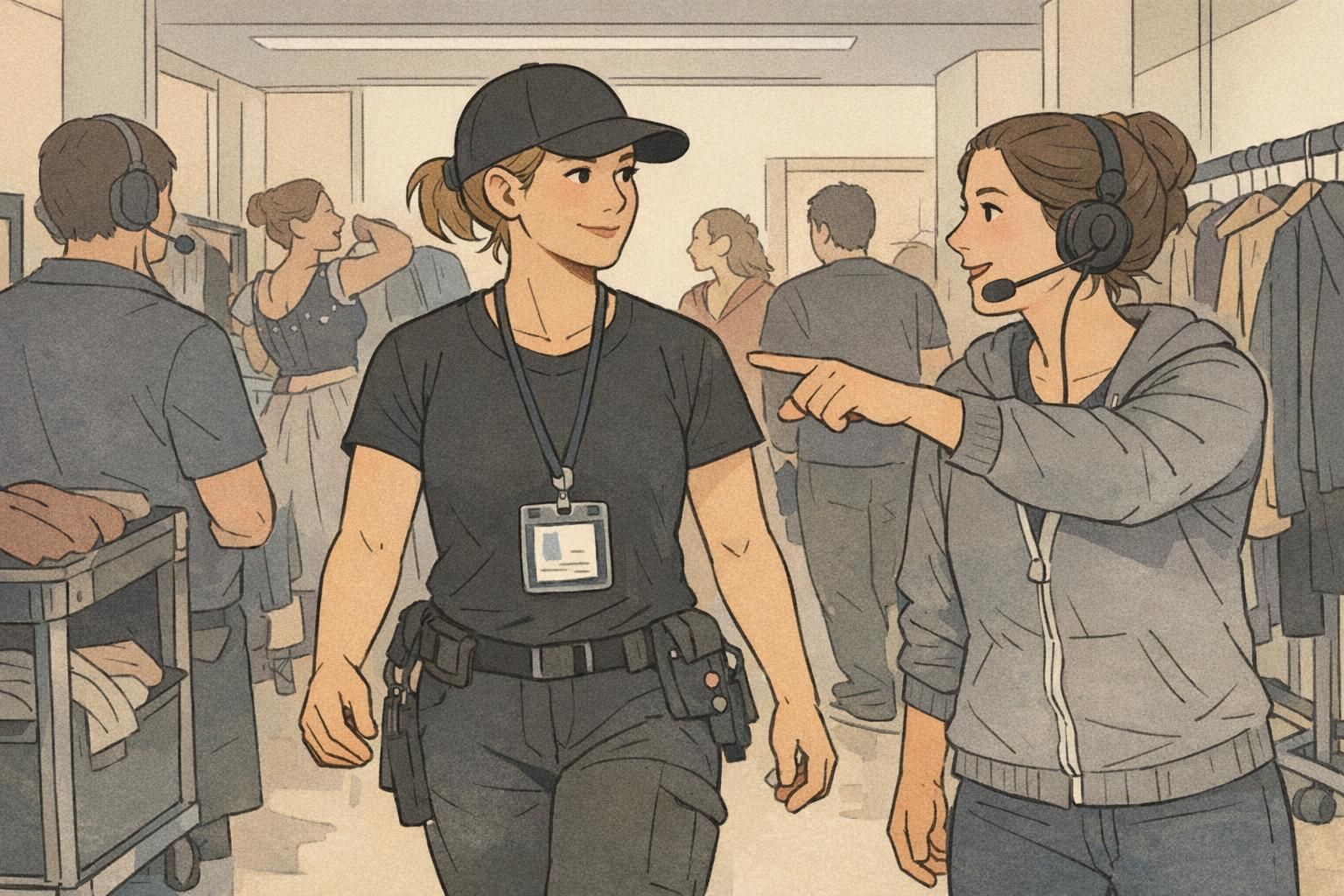
"When the swap steps are always the same, new staff pick it up fast and experienced staff stop wasting time. That’s when the system really starts paying off." – Department Supervisor
If you want a dependable shift work badge process, aim for repeatability: one station, one holder style, role kits that stay intact, and shared badge accessories that don’t vary from shift to shift.