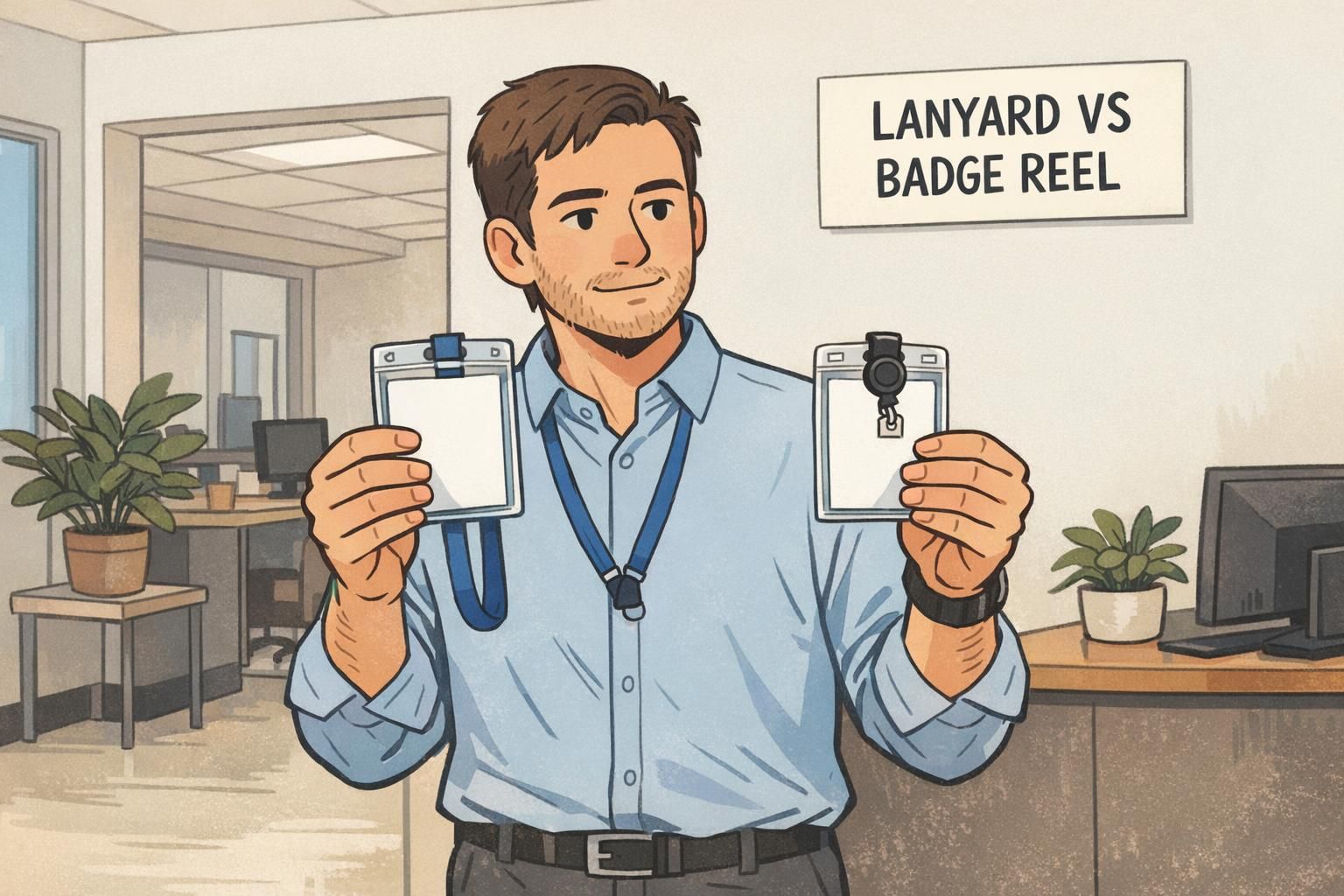
Lanyard vs Badge Reel: What’s the Real Difference?
When you’re deciding lanyard vs badge reel, you’re really choosing how your ID will behave during a normal day: how visible it is at a glance, how quickly you can present it to a reader, and how it feels after hours of wear. Both are common in workplaces, schools, conferences, and access-controlled facilities—yet they support different routines.
A lanyard is typically worn around the neck, keeping the badge front-and-center for quick visual identification. A badge reel clips onto clothing and extends on a retractable cord, so you can pull your ID to a scanner, tap point, or door reader without taking it off.
A simple way to choose: if your badge is mainly for being seen, lanyards shine; if your badge is mainly for frequent swipe/tap, reels usually feel faster and more efficient.
- Pick based on the day-to-day: visibility, scan frequency, and what’s comfortable for a full shift
- Consider your environment: visitor-facing roles often prioritize easy visual ID, while secure areas prioritize quick access
- Match the attachment to the holder so the badge stays readable and easy to present
How You Wear It: Neck Carry vs Clip-On Carry
The biggest practical difference is where the ID sits on your body. Lanyards hang around the neck and naturally place the badge in the center of the chest, which makes it easy for others to see without asking you to turn or dig for it. That’s helpful in settings where quick recognition reduces friction—think front desks, hall monitors, event staff, or any role with frequent face-to-face interactions.
Badge reels clip to something stable: a waistband, belt, pocket edge, scrub top, or a uniform placket. Instead of “hanging,” the ID stays closer to the body and only moves away when you extend it. This changes how it behaves when you walk, bend, reach, or turn: less swing, less bounce, and often less chance of the badge flipping backward.
- Lanyard carry: centered and easy to see, but can swing when you move quickly
- Reel carry: close-to-body and controlled, but depends on having a reliable clip point
- Movement matters: consider how often you lean over counters, lift boxes, or work with patients

Visibility and Professional Presence (Branding vs Low-Profile)
If your priority is quick visual identification—who someone is, what role they’re in, or whether they’re a visitor—lanyards tend to win because they keep the badge more noticeable at a distance. They also make it easier to add role color-coding or branding without needing anyone to step closer.
Badge reels are usually more low-profile. Because the badge sits closer to your clothing, it can blend in, which some workplaces prefer for a clean, minimal look. This can still work well for visual ID, but it often relies on people being closer to you to read the credential.
If you want your ID to be recognized before you even speak, lanyards are often the simplest path. If you want identification that’s present but subtle, reels are a common fit.
Does a lanyard always make an ID easier to read?
Usually, yes—because it’s centered on the chest. But readability still depends on using a holder that keeps the badge facing forward and prevents curling or flipping.
Are badge reels “too hidden” for workplaces that need visual ID?
Not necessarily. Reels can work well when the card remains front-facing and uniforms keep the badge unobstructed, but they’re typically less visible at a distance than lanyards.
Access Needs: Swipe/Tap Frequency and Reader Distance
How often you scan matters more than many people expect. If you’re tapping into doors all day, entering secure departments, releasing prints, or clocking in and out, badge reels can be quicker because you extend the card, use it, and let it retract—without taking anything off your body.
Lanyards can work well when scanning is occasional, or when the badge is primarily for visual identification. But if you’re constantly lifting a badge to a wall reader, pulling it out from under a jacket, or repeatedly taking it off and putting it back on, it can start to feel like a small but persistent interruption.
- Frequent swipe/tap: reels often reduce steps and keep the badge in a consistent place
- Occasional scan: lanyards are often fine, especially when visual ID is the main goal
- Reader distance: consider whether the card needs to reach a wall-mounted reader without strain or awkward bending

Comfort and Ergonomics Over a Full Shift
Badge wearing comfort is about more than preference—it’s about whether your attachment works with your body and your uniform for hours at a time. Lanyards are straightforward and often feel light, but some people dislike any neck contact or notice irritation during longer shifts.
Badge reels avoid the neck entirely, which many people appreciate. The tradeoff is that reels need a stable clip point, and they can tug or twist lighter fabrics if the badge pulls at an angle. Reels also tend to perform best when you’re carrying a single ID card (or a light holder).
Weight is the hidden factor. If you’re carrying multiple items—an ID plus keys, a fob, or extra cards—lanyards can distribute weight more comfortably, while reels may retract poorly or feel like they’re pulling on your clothing.
For all-day comfort, match the attachment to the load: reels for simple, lightweight setups; lanyards for visibility and for carrying more than just a single card.
What if I don’t have a good place to clip a reel?
That’s one of the most common reasons people choose lanyards—especially with dresses, loose sweaters, or uniforms without pockets/waistbands that hold a clip securely.
Can comfort change depending on the shift?
Yes. If you start a day in a jacket, then remove layers, a reel can stay consistent while a lanyard might shift. On the other hand, if you’re moving constantly, some people find the consistent “hang” of a lanyard more predictable than a clip that can rotate.
Safety and Workplace Risk: Breakaways, Snags, and Movement
Safety considerations can quickly outweigh personal preference. In environments where anything around the neck could pose a risk—such as roles with higher grab risk or where snagging is a concern—badge reels or breakaway lanyards are commonly used to reduce the chance of an incident. In areas near machinery or moving parts, minimizing anything that dangles is often a practical precaution; a reel worn higher on the torso can reduce swing compared with a longer neck lanyard.
Many organizations handle this by documenting role-appropriate guidance in a short policy: what attachment is allowed, when breakaways are required, and when close-to-body wear is preferred. If you’re aligning ID attachment options with a broader safety approach, a neutral place to start is reviewing general workplace safety expectations and your internal policies, and using reputable resources like OSHA as a reference point (source).
- Breakaway lanyards: designed to release under force in higher-risk settings
- Close-to-body wear: reduces swing and snag potential, especially during active work
- Consistency helps: written guidance keeps teams aligned across roles and departments

Durability and Maintenance: Fabric vs Retractable Mechanisms
Durability looks different for each option. Lanyards are mostly about the fabric and the hardware: over time they can fray, get soiled, or develop issues at the clasp. The upside is that there are no moving parts, so “failure” tends to be gradual and visible.
Badge reels rely on a spring and cord. With frequent scanning, lower-quality reels can lose retraction strength or show cord wear. If your team taps readers dozens of times per day, it’s often worth standardizing on sturdier reels and replacing them proactively when they stop retracting smoothly or the cord shows damage.
A practical maintenance rule: if the reel doesn’t retract reliably or the cord looks worn, replace it before it becomes an access bottleneck.
Quick Decision Rules by Role, Uniform, and Environment
If you want a fast way to choose, start with three questions: Do people need to see your badge from a distance? How often do you scan? And does your uniform give you a stable clip point? Those answers usually make the lanyard vs badge reel choice clear.
- Choose a lanyard when: you need constant, front-facing visibility (events, schools, visitor management) or your outfit doesn’t reliably support a clip-on reel
- Choose a badge reel when: you scan/tap frequently (offices, hospitals, labs, government buildings) or you want close-to-body carry with less swing
- Consider a mixed program when: visitors and event staff need instant recognition, while daily staff need faster access at readers
- Add breakaway features when: role-specific safety practices call for quick-release behavior
"We found that lanyards helped visitors and volunteers get recognized quickly, while reels made day-to-day staff entry faster because they weren’t constantly taking a badge off and putting it back on." – Facilities Coordinator
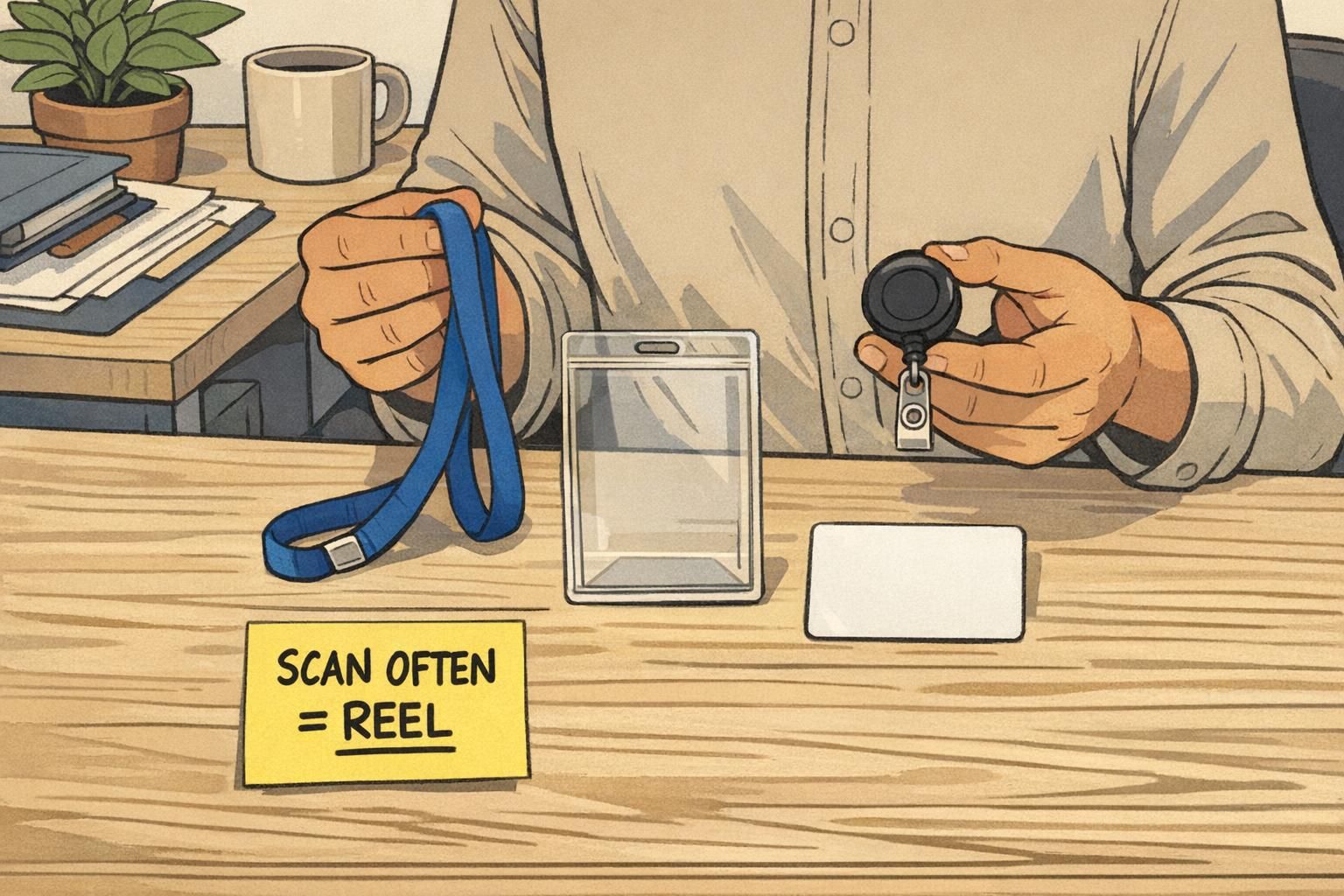
Pairing Attachments with the Right Badge Holder or Event Badge
Your attachment only works as well as the holder and badge layout. A lanyard benefits from a holder that helps the ID stay rigid and front-facing, reducing the chance it flips backward or bends. A badge reel often pairs best with a compact holder that doesn’t add unnecessary weight and makes tapping/swiping easy.
For conferences, trainings, or multi-day meetings, event badges paired with clear holders help protect printed credentials while keeping names readable throughout the day. Consistency matters here: when badge sizes and slot/hole placement are standardized, check-in goes faster and attendees are less likely to struggle with assembly.
If you’re updating a program, consider whether you need vertical or horizontal orientation, how names will be read at a conversational distance, and whether the badge needs to work with access readers. Some organizations also choose to encode ID cards (such as RFID or magnetic stripe) so the same credential handles both identification and access; if encoding is part of your setup, it’s worth confirming the attachment keeps the card easy to present without excessive bending or handling.
A simple place to start is choosing a dependable holder that fits your badge size and wear style, like clear vertical badge holders.
- For lanyards: consider rigid or semi-rigid holders to keep the badge readable and forward-facing
- For reels: keep the setup lightweight so extension and retraction stay smooth
- For events: clear holders protect printed badges and reduce smudging, bending, and reprints
- Standardization: consistent badge size and slot placement reduces daily friction for staff and attendees